Data Center Gold Rush
2025 Data Center World Conference Showcases Need For More Power
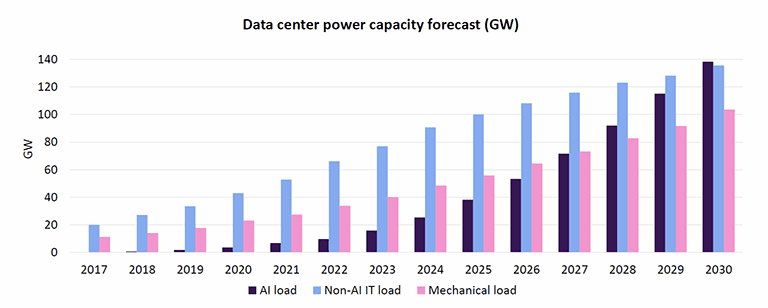
(Graphic courtesy of Omdia)
By Drew Robb
Information technology (IT) and power generation have been on a collision course, with artificial intelligence (AI) and data centers driving power demands far beyond current capacity. During Data Center World Conference 2025, speakers discussed the need for more power and the options that are being explored.
“Every new data center we build gets bigger and requires many more megawatts,” said Ana Marie Ordonez, principal solutions architect at Equinix, one of the world’s largest providers of data centers. “The expectation should be that you will need a lot more power, so build big and build bold.”
Natural Gas For The AI Data Center
US data centers currently consume about 176 terawatt hours (THw) per year of power or 20 GW of capacity. That represents 4.4% of US electricity consumption. Over the next three years, those numbers are in for a major revision. Electricity consumption by data centers will soar to levels between 325 and 580 TWh per year or 37 GW to 66 MW, representing 6.7% to 12% of total US electricity, said Dave Bell, vice president of data center and microgrid development at VoltaGrid, during his keynote address at Data Center World 2025.
VoltaGrid offers virtual pipelines for compressed natural gas (CNG). If natural gas is not available at or near a site, a virtual pipeline ensures power supply, overcoming geographic limitations. The company has CNG stations in Midland and Orla, Texas; Tucson, Arizona, and Kennesburg, Colorado.
An electric trailer-mounted fuel delivery system allows for CNG, liquefied natural gas (LNG), hydrogen, and field gas to be utilized to supply fuel to a remote site. A 2.5-MWe natural gas reciprocating generator can reach its rated load in 32.5 seconds. Its gas conditioning system lowers the carbon intensity of fuel to the generator’s optimal heating value, thereby reducing emissions.
In addition, VoltaGrid offers electric trailer-mounted mobile refrigeration units (MRUs) with inlet capacities of up to 5 MMscf/d (141,584 m3/d), multiple turndown features, and a range of inlet pressures. An electric trailer-mounted booster compressor is designed to allow low-pressure field gas to be processed seamlessly through the MRU. Additionally, a hydrogen sulfide (H2S) scavenging unit removes low concentrations of H2S from saturated natural gas.
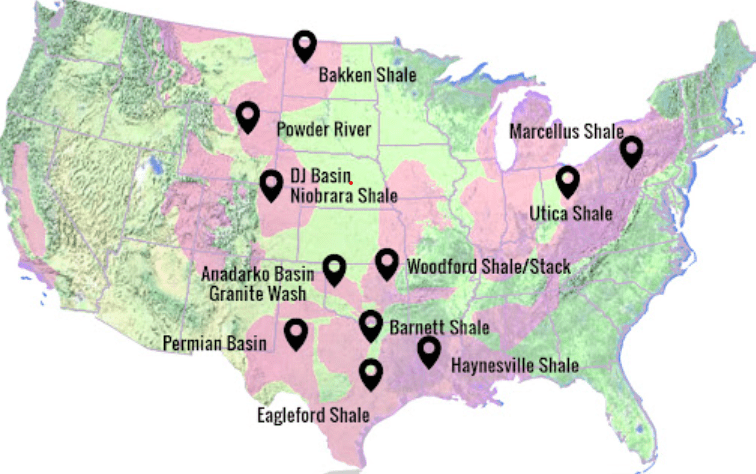
Bell advocated natural gas as the best option for the mega-data centers currently being developed. These huge AI factories require enormous amounts of power. He made his point by showing that natural gas accounts for almost half of all electricity generated in the US compared to 4% for solar and 10% for wind. Data centers consume 2.29 bcf/d of natural gas to produce about 90 TWh of electricity. That number is expected to rise to about 225 TWh by 2030. “Between 2024 and 2030, natural gas consumption by data centers will rise by almost three times,” said Bell. “By then, data centers will be using up 4.5% of US gas consumption for electricity generation.”
He recommended that those seeking power for large AI data centers look at territories such as West Virginia, Pennsylvania, Ohio, Virgina, Texas, and Oklahoma where gas is plentiful. “Get close to fuel supply and existing natural gas basins. The closer you are to the supply, the more fluidity you have and the faster you can obtain the fuel you need,” Bell said.
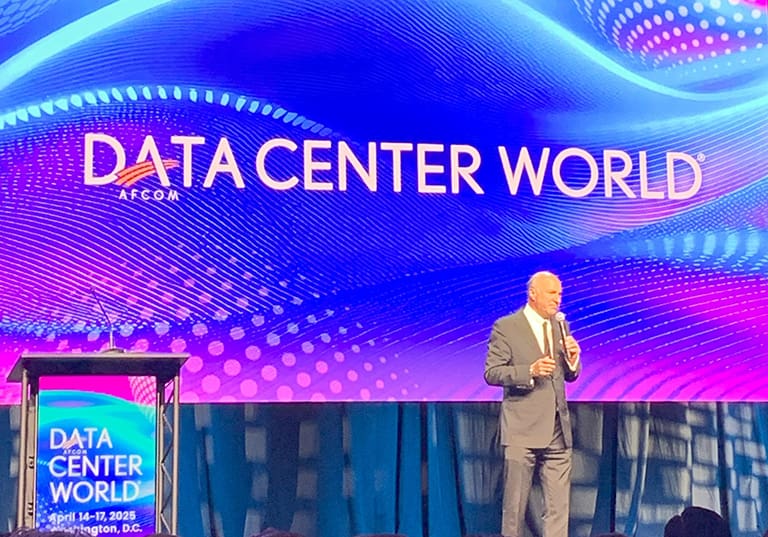
Another keynote address was delivered by Kevin O’Leary (aka Mr. Wonderful) from ABC’s Shark Tank. O’Leary believes that data centers are today’s gold rush. Accordingly, he is building the world’s largest data center in Alberta, Canada.
“The capital cost of an AI data center is so high that you have to build big,” said O’Leary.
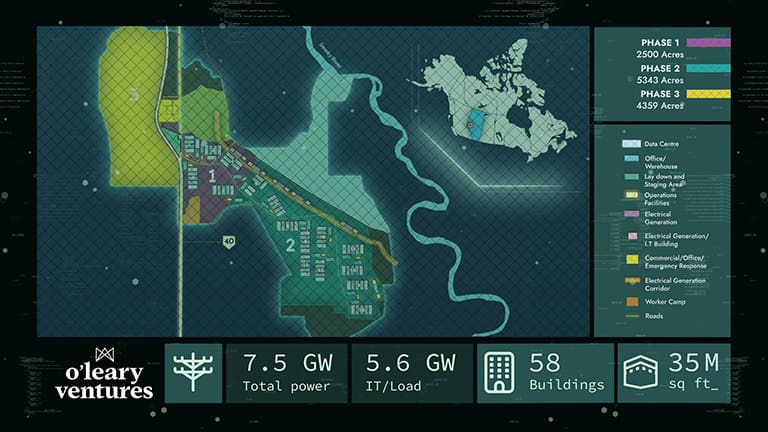
O’Leary’s Wonder Valley in the Municipal District of Greenview is already under construction. Phase one of 1.5 GW will be ready by the end of 2027 at a cost of US$2 billion. Up to 8 GW will be built in stages over the coming years.
Alberta offers an abundance of land, optical fiber connectivity, technology and utility infrastructure, and a skilled workforce. But most of all, it is blessed with an enormous amount of stranded natural gas that has previously struggled to find a market due to being distant from primary markets.
“Stranded natural gas is inexpensive, clean, and we can compress the carbon and put it underground rather than emitting it into the atmosphere,” said O’Leary. “Alberta is the motherload of stranded natural gas in North America.”
Nuclear Is Going Nuclear
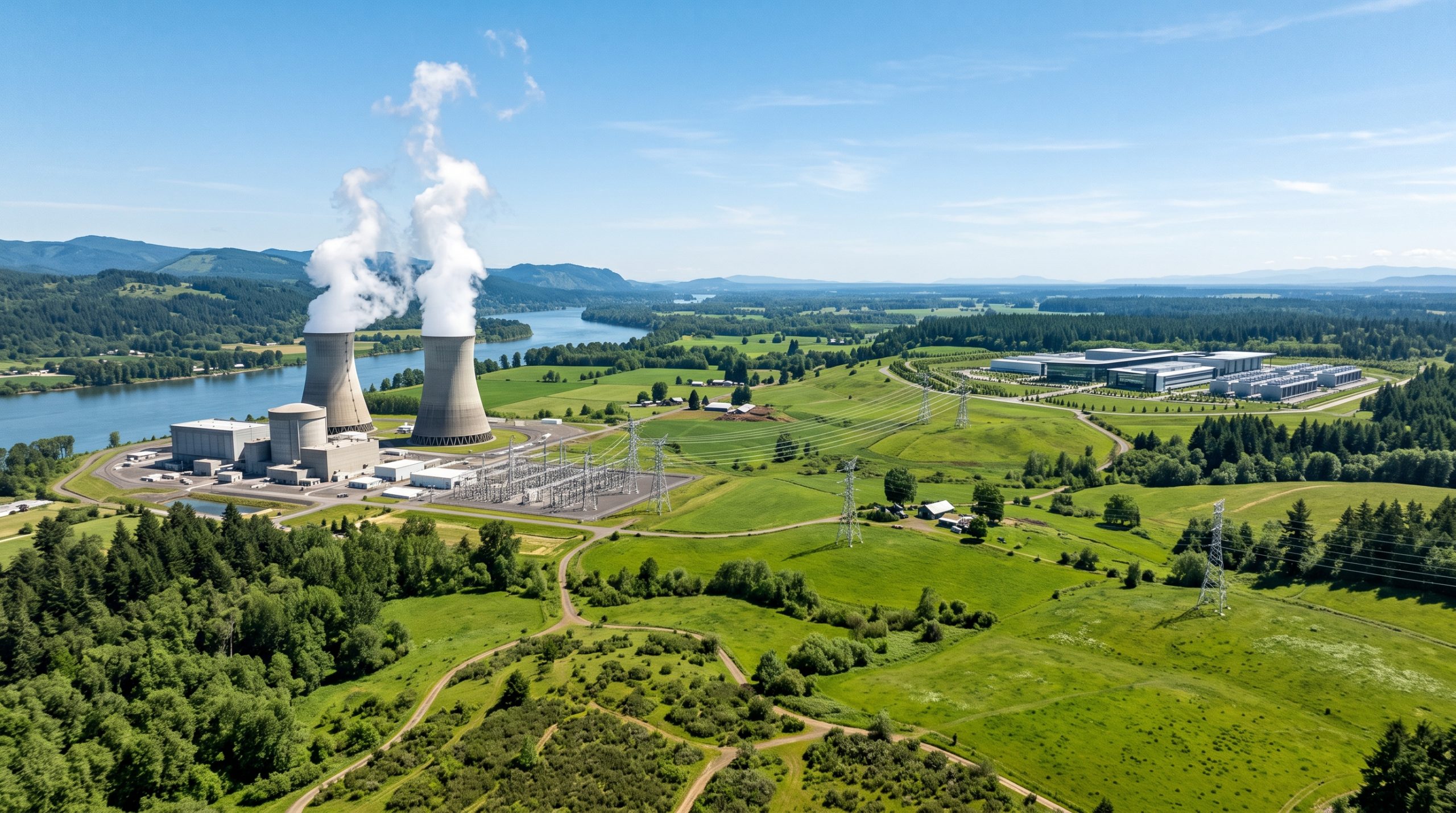
Nuclear is another winner when it comes to powering data centers. IT giants are investing billions into nuclear power:
- Amazon is providing financial backing for the deployment of 5 GW of new X-energy small modular reactor (SMR) projects by 2039 and has acquired a 1200-acre (607-ha) data center campus that is directly connected to the 2.5 GW Susquehanna Steam Electric Station (a nuclear plant) in Pennsylvania. An existing 48 MW data center operating there currently will be expanded to 960 MW.
- Microsoft and Constellation Energy plan to invest more than US$1.5 billion to recommence operations at the Three Mile Island nuclear plant in Pennsylvania by 2028 to power Microsoft AI data centers.
- Google is involved with Kairos Power in the development of 500 MW of molten salt nuclear reactors by 2035 to power its data centers.

At Data Center World 2025, Lucia Tian, head of clean energy and decarbonization at Google, showcased the partnership with Kairos Power. The project received US$300 million in funding assistance from the US Department of Energy’s Advanced Reactor Demonstration Program. Kairos Power’s 150 MW reactor has a modular design. Multiple units can be combined for larger sites.
“We aim to have an initial SMR deployment by 2030, with further expansion of the site through 2035,” said Tian. “Nuclear energy will be more cost effective and dependable than variable wind and solar.”
Rethinking Power Sources
Utility coordination and substation builds can delay new data center deployment by years. Developers are finding creative alternatives. For example, stranded wind energy attracted Applied Digital to the wilds of North Dakota. It is building a 400 MW data center beside a large, underutilized wind farm.
“AI is so power hungry that demand is outpacing the available power supply,” said Laura Laltrello, chief operating office at Applied Digital. “The biggest bottleneck is power. Major metros are tapped out, grid constrained, and slow to scale.”
Her advice to those interested in building AI factories — partner early to secure the power you need, then design for scale and build the power infrastructure, data center shell, and other elements simultaneously.
According to Vlad Galabov, an analyst at IT consultancy Omdia, more than 35 GW of data center power will be self-generated by 2030. He believes AI will drive over 50% of global data center capacity and more than 70% of revenue opportunity across all industries – but only if the power can be found.
“Those wanting to build new data centers have discovered that many utilities can’t deliver the power they need for several years,” he said. “Off-grid solutions are no longer optional for AI factories as power availability is the biggest limiting factor in the pace of AI innovation and adoption.”