Maximizing Throughput By Avoiding Engine De-Rating In Hot Ambient Conditions
By Kevin Heidebrecht
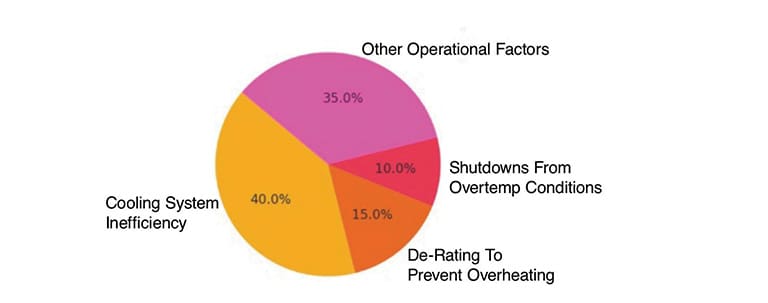
In natural gas compression, heat is the enemy. During the hottest months, engines are pushed to their limits, and traditional cooling systems often cannot keep up. Recent industry analysis shows that 40% of engine performance risks in hot weather stem from cooling inefficiencies, while 15% are due to engine de-rating, and 10% result from shutdowns caused by overheating. Combined, these factors account for 65% of the total risk impacting engine productivity during high ambient conditions.
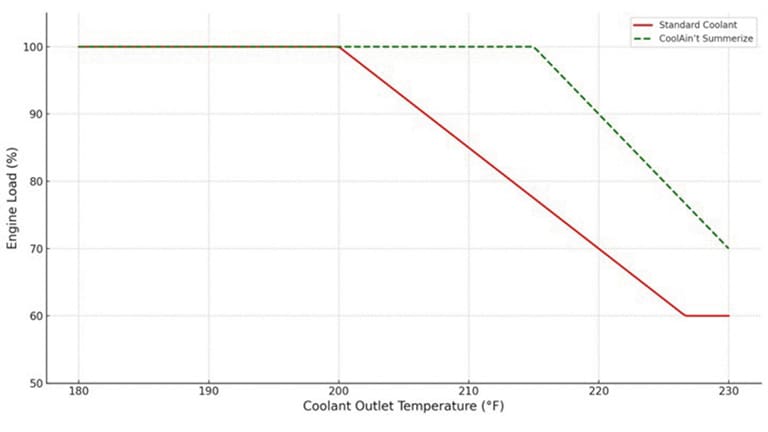
When engines overheat, operators have no choice but to de-rate reducing load and output to protect critical components. While this prevents damage, it comes at a steep cost. De-rating strands gas in pipelines and can slash output by up to 40% in extreme conditions, leaving profits on the table.
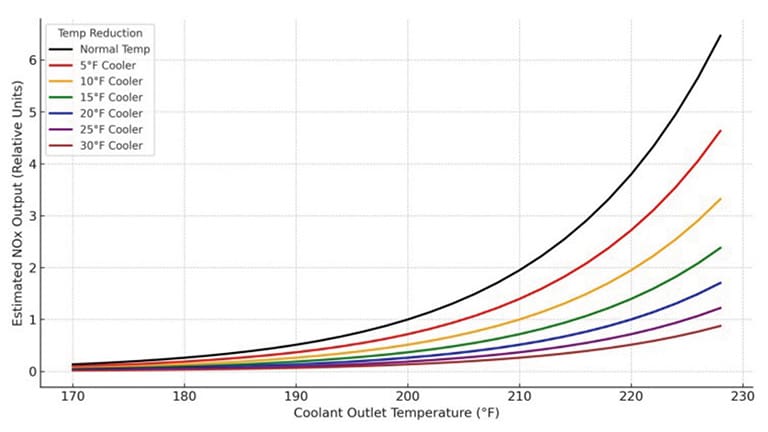
“High coolant outlet temperatures are one of the leading causes of engine inefficiency and NOx (nitrogen oxide) emissions,” said David Vannostran, president of Ultimate Chemicals. “The relationship is well-documented: higher combustion temperatures lead to exponentially higher NOx emissions, as shown in Figure 1. Even small reductions in coolant temperature can result in dramatic decreases in NOx formation, helping operators meet emissions standards while maintaining performance.”
Cooler Engines, Better Performance
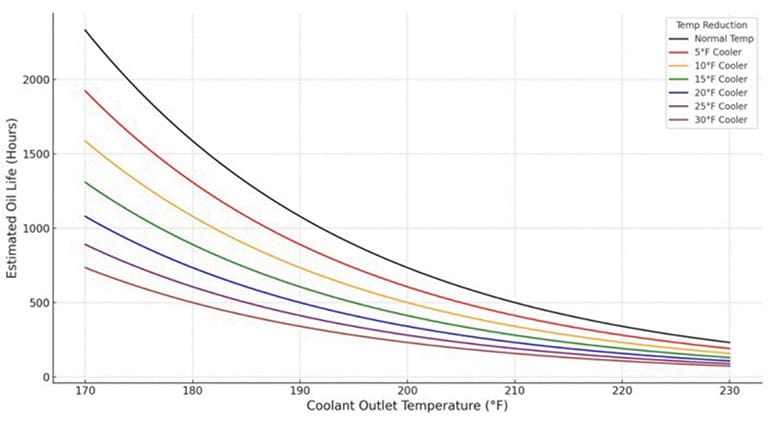
The benefits of running engines cooler extend far beyond emissions control. Lower coolant temperatures also significantly reduce thermal stress on critical components, including engine oil. As shown in Figure 2, oil oxidation rates double for every 18°F increase in temperature, meaning that overheating can rapidly degrade oil and shorten its lifespan.
For operators, this translates into more frequent oil changes, higher maintenance costs, and increased downtime. Rising coolant temperatures also put additional stress on internal components, leading to wear and tear that can result in costly repairs.
“Running cooler isn’t just about avoiding shutdowns,” explains Vannostran. “It’s about improving the overall health of the system, extending the lifespan of components, and ensuring engines operate at peak efficiency, even under extreme load conditions.”
The Solution
Designed specifically for high-load, high-temperature environments, Ultimate Chemicals developed CoolAint Summerize — a non-glycol, high-efficiency heat transfer fluid that replaces traditional glycol-based coolants during non-freezing months. Its unique formula lowers coolant temperatures by up to 20 degrees Fahrenheit, enabling engines to maintain full-load operation even in the hottest conditions.
“CoolAint Summerize eliminates many of the problems and risks associated with traditional glycol coolants, such as sludge and silicate buildup,” said Vannostran. “It also includes cleaning and corrosion-inhibiting additives that keep systems running smoothly. With CoolAint Summerize, engines can operate at full capacity up to 215°F (103°C), avoiding de-rating and maximizing throughput during peak summer demand. The result? More uptime and higher profits.
Financial Advantage
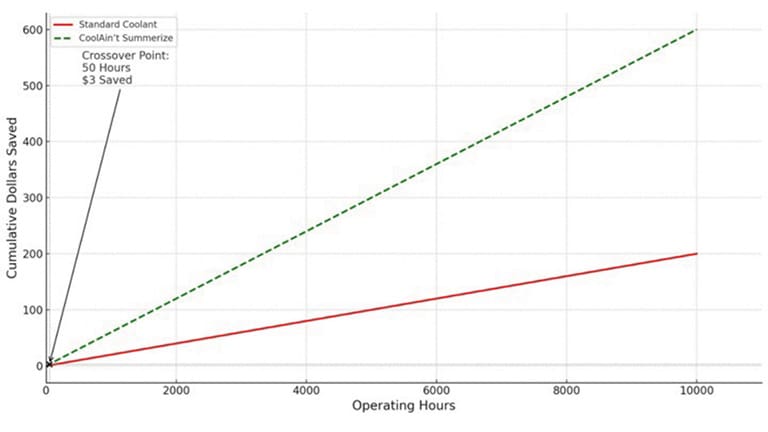
While the operational benefits of CoolAint Summerize are clear, the financial impact is equally impressive. According to Vannostran, the product becomes more cost-effective than traditional glycol coolants after just 500 operating hours, with savings accelerating as runtime increases (Figure 5).
Field data compiled from several locations throughout Texas, Oklahoma, and New Mexico show:
- Reduced Fuel Consumption: Cooler engines run more efficiently, requiring less fuel.
- Extended Oil Life: Lower temperatures slow oil degradation, reducing the need for frequent changes. (Figure 3)
- Lower Maintenance Costs: Cleaner systems and reduced thermal stress mean fewer repairs and less downtime.
- Avoided De-Rating: Engines can operate at full capacity, ensuring maximum throughput and revenue. (Figure 4)
Using conservative assumptions, Vannostran estimates that operators save approximately US$0.07 to US$0.08 per operating hour with CoolAint Summerize. “When you multiply that across hundreds of engines running thousands of hours, the financial impact is significant,” he said.
Environmental Edge
In addition to boosting performance and profits, CoolAint Summerize helps operators reduce their environmental footprint. By lowering combustion temperatures, the product dramatically reduces NOx, carbon monoxide, and hydrocarbon emissions. This not only helps companies meet regulatory requirements but also enhances their environmental, social, and governance (ESG) scores.
“Lower temperatures equal lower emissions,” said Vannostran. “It’s as simple as that. And by reducing thermal stress and extending component lifespan, we’re also reducing waste and improving sustainability.”
According to Vannostran, other environmental and operational benefits include:
- Extended lubricant life: Less oil degradation means fewer oil changes and less waste.
- Cleaner systems: CoolAint Summerize prevents silicate dropout and sludge buildup, ensuring optimal flow and efficiency.
- Reusable coolant: Operators can drain and store glycol coolant during summer months, reintroducing it during winter for freeze protection.
“CoolAint Summerize includes Ultimate Chemicals’ CRI Corrosion Rust Inhibitor, which keeps systems 99% rust-free,” said Vannostran. “It’s a cleaner, more efficient solution that improves reliability and reduces waste.”
Seasonal Optimization
One of the unique advantages of CoolAint Summerize is its seasonal flexibility. In moderate climates, operators can switch to CoolAint Summerize during summer for optimal performance, then return to traditional glycol-based coolants during winter for freeze protection.
“Draining and storing glycol coolant is simple,” said Vannostran. “Operators can flush the system if needed, run CoolAint Summerize during the hot months, and reintroduce glycol when temperatures drop. This cycle not only saves money but also ensures the system is optimized for both summer and winter conditions.”
Vannostran continued, “For natural gas compression operators, the summer heat no longer has to mean de-rated engines, stranded gas, and lost revenue. With CoolAint Summerize, operators can maximize throughput, reduce downtime, and improve system efficiency-all while cutting costs and reducing their environmental impact.
“CoolAint Summerize is more than a coolant. It’s a performance booster, a cost saver, and a sustainability solution all in one,” added Vannostran. “By keeping engines running at full capacity, even in extreme heat, it ensures operators can move more gas, reduce expenses, and boost profitability during the hottest months of the year.”