Baker Hughes Acquires Chart Industries
US$13.6 Billion Deal Moves Baker Hughes Toward A Lower-Carbon, More Resource-Efficient Future
By Brent Haight and Daniel Foelber
Baker Hughes will acquire Chart Industries (Chart) in an all-cash deal that is valued at US$13.6 billion. The move puts the breaks on the previously announced “merger of equals” between Chart and Flowserve. The merger, announced on June 4, was based on a combined enterprise value of US$19 billion, with Chart shareholders owning approximately 53.5% of the combined entity. That would have meant Chart shareholders owned effectively US$10.17 billion in enterprise value, illustrating the premium Baker Hughes paid relative to the merger of equals. As such, Chart was more than happy to fork over a whopping US$266 million to Flowserve in termination fees.
To put the Baker Hughes/Chart deal into context, when GE’s oil and gas business merged with Baker Hughes to form Baker Hughes, a GE Company in 2017, the combined company was estimated to have US$32 billion in combined revenue, with GE owning 62.5% of the entity, Baker Hughes shareholders owning 37.5%, and GE contributing US$7.4 billion to the new partnership. GE then exited the oil and gas industry in 2018.
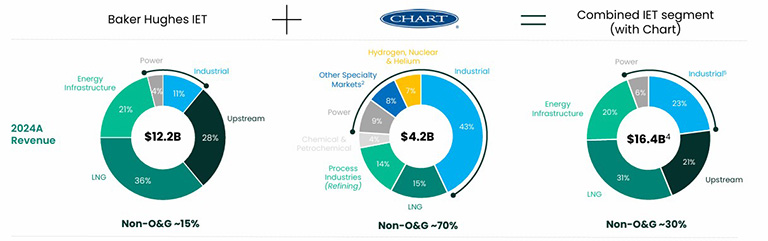
Baker Hughes has grown as lot since then, with 2024 revenue of US$27.83 billion. Combined with Chart’s 2024 revenue of US$4.16 billion, the newly combined entity coincidentally has US$31.99 billon in 2024 revenue, making it roughly the same size as BHGE according to that metric. However, this version of Baker Hughes couldn’t be more different.
Doubling Down On Sustainability
The mega deal moves Baker Hughes toward a lower-carbon, more resource-efficient future rather than one betting solely on oil and gas. The acquisition brings together a highly differentiated set of capabilities from two heavy weights to solve complex energy challenges and support customers’ sustainability goals.
Chart’s expertise in process technologies across compression, thermal, cryogenic, and specialty solutions strengthens Baker Hughes’ position as an energy and technology company, and more than doubles its presence in non-oil and gas business segments.
“The combined portfolio will be more industrial and less cyclical, positioning Baker Hughes to deliver more resilient and consistent long-term performance,” said Ganesh Ramaswamy, executive vice president, Industrial & Energy Technology (IET) at Baker Hughes during a conference call discussing the acquisition. “We are broadening our reach beyond our core markets, which currently include upstream oil and gas infrastructure and LNG [liquefied natural gas], as well as new energy and distributed power generation.”
Expected to close mid-2026, Chart will operate as a standalone business unit within Baker Hughes’ IET segment, maintaining its own leadership team and commercial focus.
“Chart is a leader in heat exchanges, small scale compression, and cryogenic equipment. Its global scale enables them to support large and complex energy and industrial projects, while also significantly enhancing the aftermarket and lifecycle value of its offerings,” said Lorenzo Simonelli, chair and chief executive officer of Baker Hughes during the conference call. “Chart has a strong financial profile, with US$4.2 billion in revenue in 2024, a three-year organic revenue CAGR [compound annual growth rate] of 14%, and a 24% EBITDA [earnings before interest, taxes, depreciation, and amortization] margin. The acquisition sharpens our focus on the most attractive and resilient energy and industrial markets, expands our capabilities through a highly complementary product and technology portfolio, and enhances our ability to deliver more differentiated solutions. It also strengthens our aftermarket services business, a key driver of recurring high margin revenue, and is expected to deliver strong earnings secretion and returns. Overall, the transaction supports stronger growth and margin expansion that will further enhance the durability of Baker Hughes’ earnings and cash flow. This acquisition is a strong strategic fit and accelerates our vision to become a leading energy and industrial solutions provider.”
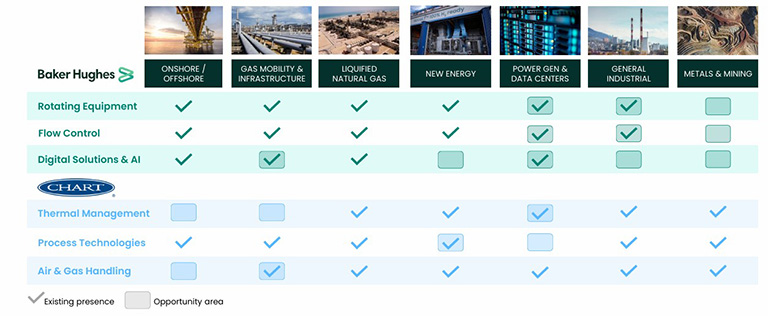
Baker Hughes’ core competencies in rotating equipment, flow control, and digital technology pair well with Chart’s competencies in heat transfer, air and gas handling, and process technologies. Chart is well positioned to deepen Baker Hughes’ exposure to high-growth markets such as data centers and low carbon energy. The acquisition also broadens Baker Hughes’ exposure to more durable industrial sectors including industrial gas, metals and mining, and food and beverage.
“Together, we are better positioned to meet a diverse set of customer needs with tailored solutions that reflect long-term industry trends and shifting market demands, thereby enhancing our presence in high growth sectors such as LNG, data centers, and power generation,” said Simonelli. “Data centers are a rapidly expanding vertical in the global economy and an area where this combination allows us to better serve our customers. Data centers consume significant amounts of energy in order to maintain competitiveness in the sector. It is essential to ensure both a reliable and resilient power supply, as well as effective thermal management systems capable of addressing the substantial heat output from high performance computing operations. This is exactly where Baker Hughes and Chart come together in a differentiated way. Baker Hughes provides turbines that deliver distributed power generation while Chart supplies industrial chillers that help reject the heat from advanced computing environments, especially GPUs [graphic processing units] operating above 200˚C [392˚F]. In addition, Chart brings cryogenic tanks for onsite storage. This is not only a complete solution, it is a more efficient one. We can significantly lower energy intensity across the system by utilizing waste heat from turbine exhaust and chip-level thermal loads. This combination positions us to deliver differentiated, high efficiency infrastructure solutions for one of the fastest growing and most energy intensive sectors of the economy.”
Identifying Cost Savings
Baker Hughes has identified US$325 million of annualized cost synergy opportunities by the end of year three. Baker Hughes intends to drive productivity improvements by leveraging its scale in manufacturing and consolidating the companies’ supply chains, as well as optimizing costs across selling, general, and administrative expenses, and research and development (R&D) functions.
“We will continue investing in R&D across the combined portfolio, as technology innovation remains central to the value proposition of both companies,” said Ahmed Moghal, executive vice president and chief financial officer of Baker Hughes during the conference call. “Across the combined company, we see meaningful commercial synergies. This includes opportunities for expanded market coverage and broader product offerings, as well has higher attachment rates and enhanced penetration on Chart’s installed base.”
Chart operates 65 manufacturing locations with over 50 service centers globally. The combined company will have a large and structurally growing installed base creating opportunities to drive growth in aftermarket products and services, as well as digital services using Chart’s Uptime digital platform. Baker Hughes’ expansive service footprint is expected to increase service rates for Chart’s installed base, driving more profitable, recurring revenue across the combined portfolio.
“There are also several complimentary elements that position us to accelerate the growth profile for our aftermarket,” said Ramaswamy. “First, we can extend our expansive service footprint and strong customer intimacy in regions like the Middle East and Asia Pacific. Chart has a large installed base but limited aftermarket service coverage. Second, we see the same opportunity to deploy Baker Hughes’ service capabilities into underserved end markets such as metals and mining. Third, by integrating Baker Hughes’ global service network and AI driven platforms with Chart’s digital tools, we can transform the customer experience across the full life cycle of the combined install base. For example, platforms like Baker Hughes’ iCenter and Chart’s Uptime enable proactive diagnostics and real-time asset monitoring leading to smarter operations, increased uptime, and lower total cost of ownership. Together we can transition from reactive service to predictive performance. In short, this combination unlocks significant aftermarket growth potential, further enhancing both the durability and quality of Baker Hughes.”
“This acquisition is a milestone for Baker Hughes and a testament to our strong financial execution and strategic focus as we continue to define our position as a leading energy and industrial technology company,” said Simonelli. “We know Chart well, having worked alongside them on many critical energy infrastructure projects. Their products and services are highly complementary to our offerings and strongly aligned with our intent to deliver distinctive and efficient end-to-end lifecycle solutions for our customers across their most critical applications. The combination positions Baker Hughes to be a technology leader that can provide engineering and technology expertise to meet the growing demand for lower-carbon, efficient energy, and industrial solutions across attractive growth markets such as LNG, data centers, and new energy.”
Chart’s Buying Spree
Baker Hughes’ acquisition of Chart is a stamp of approval on the company’s flurry of deals and shakeups in the last four years.
In 2023, Chart bought Howden, expanding the company’s presence in air and gas handling solutions, including compressors, fans, and heat exchangers.
In 2022, Chart bought Cryogenic Service Center, an aftermarket play in the Nordic region, and Fronti Fabrications, a specialist in engineering, machining, and welding for the cryogenic and gas industries, also supplying new build pressure vessels and repairs.
In 2021, Chart bought Earthly Labs, a small-scale carbon capture systems provider, which was a big move at the time that expanded Chart’s presence in the carbon capture industry. That same year, Chart bought LA Turbine as a play on turbomachinery process and solutions options, especially in hydrogen and helium liquefaction. It also bought AdEdge Holdings, which opened the door to Chart’s entry in the water treatment market. Chart also strengthened its position in cryogenic capabilities by acquiring Cryo Technologies, a customer-engineered process systems company, in 2021.
Together, these deals diversified Chart’s business, expanded its position in hydrogen and carbon capture, and boosted its core position in the cryogenic and industrial gas markets. These moves were integral in packaging Chart into a desirable acquisition target for Baker Hughes. But to make sense of why Baker Hughes would be interested in all of these businesses, it’s important to understand just how much the company has doubled down on LNG and energy transition investments in recent years.
A Titan Of The Energy Transition Industry
Baker Hughes has been taking the LNG industry by storm by providing critical turbomachinery to many of the largest LNG projects in operation or under construction. The company’s facilities in Italy have been packaging turbine/compressor trains for a variety of project scopes and sizes by leveraging decades of experience in the gas and LNG space and proven solutions to accomplish modern projects that are more complex than ever before. The company continues to lower emissions and reduce costs for its customers and has invested in developing new compression solutions that can thrive in a low-carbon future.
In June, Baker Hughes sat down with Gas Compression Magazine to discuss its new energy solutions, where the industry stands, and where it could be headed. “The greatest challenge in this moment is meeting growing demand across the energy spectrum for a variety of compression technologies with very different requirements, operating environments, and specifications,” said Francesco Cangioli, centrifugal compressor platform leader at Baker Hughes. “The oil and gas market has experienced robust growth in recent years. At the same time, we are now witnessing an incredible momentum in new energy solutions. As an original equipment manufacturer, Baker Hughes has expanded this focus through its Climate Technology Solutions business unit to satisfy the need of developing compressors and equipment to incorporate new energy solutions in the global energy sector.”
Cangioli also discussed the importance of digitally integrating all kings of compression to meet intensifying demands across the energy sector. “The industry should focus on enhancing connectivity for remote monitoring and diagnostics, unmanned or less-manned operations such as controlled plant operations with robotic inspections, and adopt more flexible solutions to maximize process capabilities.”
Baker Hughes recently launched a cloud-based solution that connects subsurface and surface data across carbon capture infrastructure. Called CarbonEdge, the solution delivers precise, real-time data and alerts on carbon dioxide (CO2) flows across carbon capture, utilization, and storage (CCUS) infrastructure, including carbon capture and compression, pipeline transportation, and subsurface storage. According to Baker Hughes, this connectivity across the entire CCUS project life cycle enables customers to identify and manage risk, improve decision-making, enhance operational efficiency, and simplify regulatory reporting. CarbonEdge is a game changer for advancing CCUS infrastructure and helping the industry grow exponentially over the next decade.
The evolution of Baker Hughes’ LNG lineup and its emphasis on digital integration through tools like CarbonEdge illustrate why it would pursue an energy transition company like Chart. Thanks to the last few years of dealmaking and organic investments by Baker Hughes and Chart, Baker Hughes can scale Chart’s diversified business segments even though they branch into end markets Baker Hughes wasn’t involved in prior to the acquisition.
Follow The Breadcrumbs
In the near-term, economic factors, supply, and demand will continue to drive natural gas dynamics. After all, the accessibility, affordability, and reliability of oil and gas has made it the backbone of the global energy sector. But for oil and gas to play a role in the age of artificial intelligence, the industry must continue to evolve to reduce emission and improve cybersecurity.
While no one has a crystal ball, we can learn a lot about were the oil and gas industry is headed by following the breadcrumbs of companies like Baker Hughes. Right now, the breadcrumbs are leading toward technological innovation. Long-term, the big winners could be the companies that have embraced the energy transition paradigm shit rather than worrying just about costs and near-term profitability.
Just eight years ago, Baker Hughes was folded into GE Oil & Gas in a mega merger. Fast forward, and the Baker Hughes of today couldn’t be more different.
The acquisition of Chart expands on the breadcrumbs Baker Hughes has been laying before our feet for years — a trail that points to a new direction for a technology driven energy company that embraces what has worked in the past while also keeping an open mind for what will thrive in the future.