Michelin, Voliris For Automated Hydrogen Airship
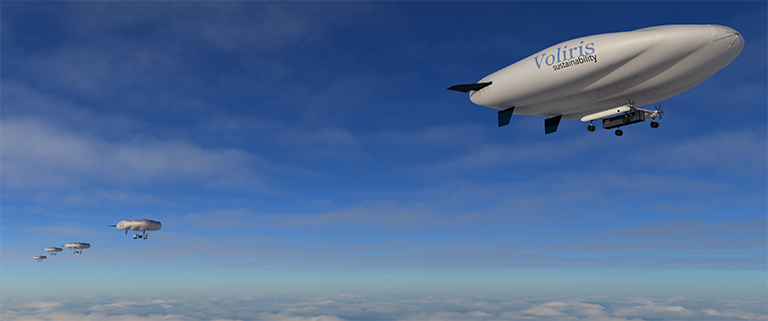
Michelin Inflatable Solutions will collaborate on the development of Navette Aérienne de Transport Automatique de Containers (NATAC), the automated container transport air shuttle developed by Voliris.
This air shuttle is a hybrid solution combining features of airships and cargo aircraft. The NATAC requires no paved runway for takeoff, helping to limit the impact of land artificialization. To transport freight with zero carbon dioxide (CO2) emissions, the aircraft is designed to be 100% hydrogen-compatible, with hydrogen eventually serving as both fuel and lifting gas. Lastly, its autonomous flight system enables safe, unpiloted operations, allowing it to reach areas that are difficult to access or lack heavy infrastructure. By partnering with Voliris, Michelin Inflatable Solutions is shaping the future of composites and air freight.
Michelin Inflatable Solutions brings its expertise in composite materials and their assembly to the service of growing technological products. By developing industrial methods for assembling technical materials, Michelin shares its knowledge of materials to support the manufacture of the NATAC’s wing envelope. The Voliris NATAC aims to transport freight with zero carbon dioxide CO2 emissions, using a flying wing suited to areas with limited infrastructure. Heavier than air, this aircraft requires no ballast when unloading its cargo and could transform the air freight sector.
Segmented into five lobes, the wing envelope has a total volume of 882,867 ft2 (25,000 m³) and arrives folded at the deployment site before being inflated. Its geometry is maintained by a pulley system that varies the volume by adjusting its aerodynamic shape at different altitudes. In addition to this internal tension, the envelope must withstand significant external loads from the cables carrying the cargo up to 33 tons (30 tonnes) mechanical stresses caused by inflation pressure across a large surface area 86,111 ft.2 (8000 m²), and the requirement to remain impermeable to helium and, ultimately, hydrogen.
Voliris and Michelin Inflatable Solutions plan to manufacture a first full-scale demonstrator of the NATAC wing by 2028 for ground testing and validation of the shuttle’s on-site deployment. This full-scale ground-based envelope will be the second key milestone for the Voliris NATAC project, following successful flight tests of a 1/7-scale shuttle prototype. To operate in any location, the NATAC has a distinctive feature: it can be shipped in 10 standard 40-foot containers and assembled directly at the departure site. The envelope must therefore be foldable without compromising its integrity, which presents an additional challenge for Michelin Inflatable Solutions that requires the combination of materials science with expertise in folding-induced stresses.