Data Center Sustainability
Combined Cycle Natural Gas Plants Integrated With Carbon Capture To Power Next-Generation AI Factories

A few years ago, most hyperscalers and data center developers issued grand designs that would achieve net-zero by 2030. The artificial intelligence (AI) race has trumped many of those ambitions.
The same natural gas plants that were strenuously avoided a couple of years ago are now viewed as the speediest route to powering next-generation AI factories.
Sustainability remains important, but it has moved down the priority list. Nevertheless, new approaches continue to be devised to unify the needs of immediate power with net-zero goals. A novel way to deliver reliable, low-carbon power at scale is to build combined-cycle gas turbine (CCGT) plants with integrated Carbon Capture and Storage (CCS). Cost, though, remains a concern.
A study by engineering firm Burns & McDonnell estimated combined-cycle capital expenditures (capex) to be between US$1300/kW and US$1800/kW. If you add in 90% carbon capture, capex would more than double.
That’s why Bryan Lofgreen, principal engineer for carbon capture at engineering, procurement, and construction (EPC) firm Kiewit, believes the economics of CCGT+CCS only work when original equipment manufacturers (OEMs) and EPCs collaborate from the start. Thus, his company is partnering with GE Vernova to streamline project development, lower costs, and bring CCS+CCGT projects to market.
“Tighter design integration can improve capital utilization and reduce operating costs,” said Lofgreen.
There are multiple ways to decarbonize both existing and future gas power plants. Pre-combustion methods include using near-zero- or carbon-neutral fuels such as hydrogen, renewable natural gas, ammonia, or biofuels. Unfortunately, these alternative fuels are often unavailable, too expensive, or still in the early stages of technical maturity.
Post-combustion is all about removing carbon from the plant exhaust. The most workable approach currently available is liquid solvents (amines). There are emerging solutions, too, such as solid sorbents, cryogenic techniques, and membrane-based technologies.
“These emerging technologies are probably five or more years into the future,” said Matthew Davidsaver, CCS product champion at GE Vernova.
Answering The Call
Recent forecasts on US data center power demand are all over the map. Analyst firm BloombergNEF believes that it could exceed 106 GW by 2035. Some estimates are much higher. This sudden surge in demand for energy has brought about a change of heart among hyperscalers and data center developers.
“If you go back 2.5 years, Amazon would not even answer a phone call from GE Vernova,” said Davidsaver. “That changed a year ago and now they want all the gas turbines they can get. They still have sustainability goals, but they have been impacted by speed to power.”
His message that coal-to-gas switching brings about a big drop in emissions (45%) is finally getting through. When you introduce the latest generation of gas turbines coupled with CCS, you can reach a 95 to 96% reduction in total captured carbon dioxide (CO2) in the flue gas stream.
However, building a traditional CCGT plant takes time. Bolt on what is essentially a large chemical plant on the backend for CCS, and you introduce a lot of complexity. Hence, CCGT+CCS might take five to seven years to build.
“Working closely together, Kiewet and GE Vernova have taken that down to 30 to 42 months,” said Davidsaver. “If it’s a fully integrated CCGT+CCS, you can bring costs down by 10%.”
CCS Mechanics
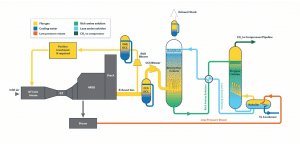
CCS requires a lot of heat to capture CO2. The latest H-Class turbines have higher firing and exhaust temperatures and can generate sufficient steam in the heat recovery steam generator (HRSG) for CCS. Davidsaver said care should be taken to extract the steam from the HRSG at the right point, as you can negatively impact efficiency. It is often best to use lower-pressure, lower-temperature steam for CCS. But if you remove too much low-pressure steam from the HRSG, reliability problems can plague a project unless the steam turbine and HRSG are specifically designed for this type of service.
Parasitic losses must be taken into account, as the gas turbine drives CCS equipment. “If you remove a third of the exhaust gas for the process and are using steam for both the production of electricity and CCS, you have to devise the system, so it functions effectively,” said Davidsaver.
The GE Vernova/Kiewit design includes direct contact coolers (DCC) to clean and cool coal exhaust gas, as well as blowers, an absorption column, a stripper column, and compressors to either store the carbon underground or transport it via pipelines. It also includes exhaust gas recirculation (EGR), which returns exhaust from the turbine to the compressor and into the combustion chamber to improve CCS performance and economics. This increases efficiency, allowing the absorber tower to be smaller. This also helps lower capex and operating expenditures (opex) while capturing more carbon, increasing part-load efficiency, and boosting power output. A recent design eliminates the need for an exhaust blower while raising reliability by integrating GE Vernova and Kiewit controls.
Net Zero Teesside CCS
There are already several ongoing large-scale CCGT+CCS projects well underway. At Net Zero Teesside Power (NZT Power) in the UK, for example, Technip Energies leads a consortium with GE Vernova and local construction partner Balfour Beatty, supported by technology partner Shell Catalysts & Technologies. They are executing a major CCS contract in the Northeast of England that aims to be the world’s first gas-fired power station with CCS. Up to 2 MTPA of CO2 will be captured, transported, and permanently stored. The plant will produce up to 742 MW of low-carbon power, equivalent to the average annual electricity needs of more than 1 million UK homes.
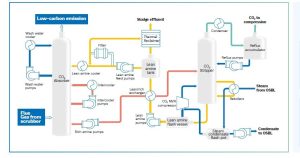
This new-build facility is installing Shell Catalysts & Technologies’ CANSOLV CO₂ Capture System, known as Canopy C+, an amine-based carbon capture solution that is said to balance capex and opex with a carbon capture recovery rate of above 95%. Canopy C+ will integrate with the GE Vernova gas turbine, a steam turbine, a generator, and an HRSG to convert fuel to electricity and capture carbon. Captured CO₂ from the power station will be conditioned and compressed before entering the pipeline system. The project plans to transfer CO₂ into a wider gathering network, which connects to injection wells at the offshore Endurance reservoir in the UK Central North Sea.
“Net Zero Teeside will be operating on the grid by 2028 with a carbon capture guarantee of more than 95%,” said Davidsaver.
US CCS Project
Another ongoing CCGT+CCS project is the Broadwing Energy Center in Decatur, Illinois, which will become the first of its kind in the US Broadwing will store about 2 MTPA of CO2. Lofgreen said it will supply low-carbon electricity to Google and Archer Daniels Midland (ADM) and steam for processing operations by ADM.
The carbon capture plant at Broadwing comprises a quencher that cools the flue gas from the HRSG to support removal of CO2 in the absorber. The absorber cools the flue gas as it passes through an amine/water solution, which absorbs CO2. The amine chemically reacts with the CO2 in the flue gas, bonding with the CO2 to form a stable compound, thus capturing the CO2 from the gas stream. The regenerator heats the solution to release the absorbed CO2. CO2 compressors then compress the CO2 into a liquid form to be permanently sequestered underground nearby. The carbon that is captured will be permanently stored onsite using ADM’s carbon capture and storage capabilities.
Broadwing is slated to begin producing power and 1.5 million pounds (680,000 kg) of steam an hour by the end of 2029. The carbon capture component should be operational by early 2030. The Broadwing Energy Center will employ a single Mitsubishi Power M501JAC gas turbine.
“There are credible CCGT+CCS projects moving ahead,” said Lofgreen. “Data center demand is driving CCS development at scale.”