Hands-On Training
Cooper Machinery Service’s Mazerole Training Center Develops The Next Generation Of Engine And Compressor Professionals
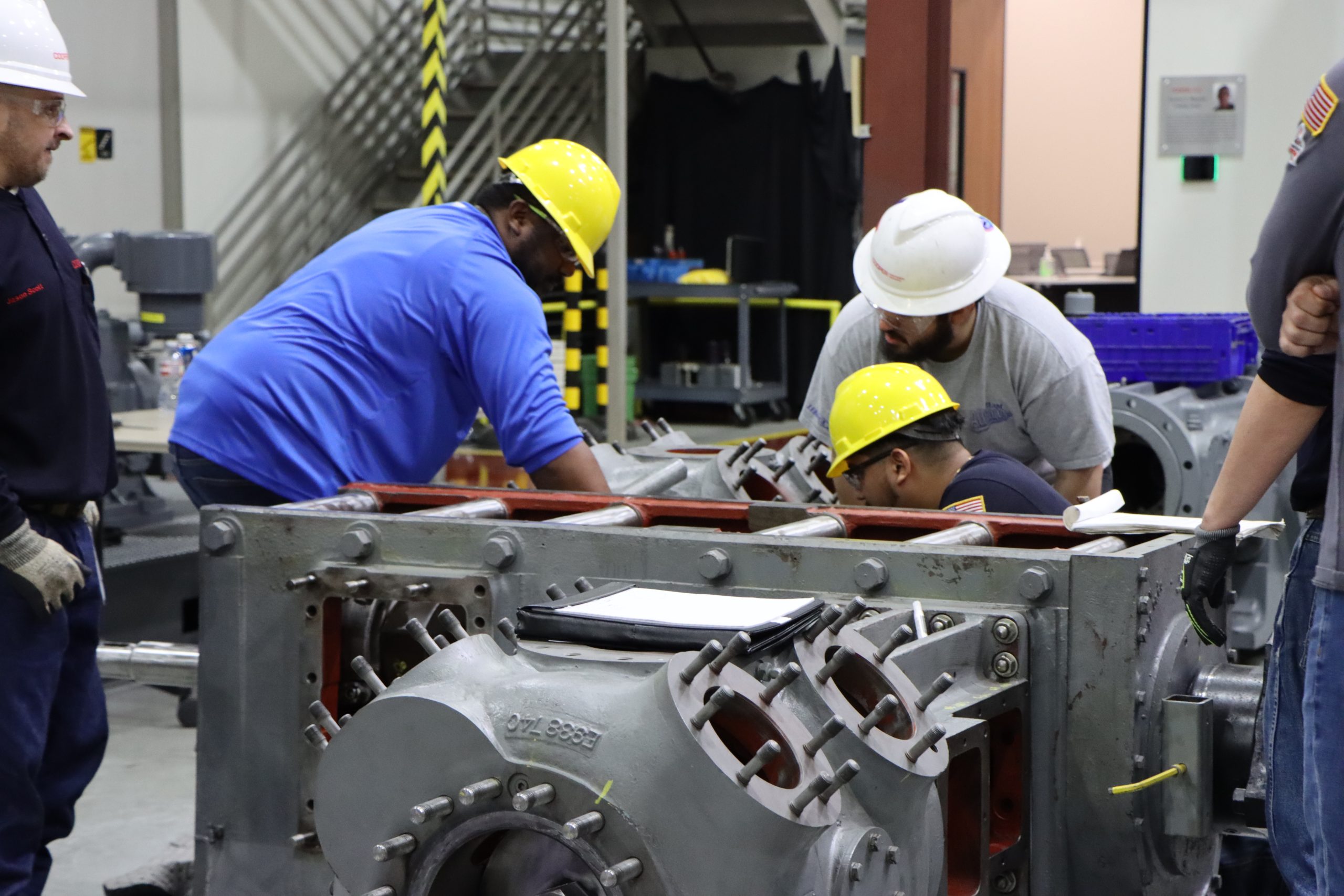
Training plays a critical role in safety and risk management. Proper training reduces the likelihood of equipment failure, workplace incidents, and downtime. When technicians understand how to perform a task and why it matters, they make better decisions in the field. This improved decision-making protects people, equipment, and the customers who depend on technicians to keep their operations running. As the energy industry continues to evolve, the demands placed on technicians and customers are only increasing. Cooper Machinery Services (Cooper) opened its Anthony G. Mazerole Training Center in 2022 and continues to invest in the facility and expand its training opportunities.
“Training provides Cooper Machinery Services with the opportunity to ensure that both our internal workforce and our customers have the knowledge and skills necessary to effectively maintain our equipment and safely support continued energy production,” said Jason Edwards, director of training, at Cooper. “This is important work that enables businesses and communities to have the reliable power they need.”
Mazerole Training Center
The majority of open-enrollment courses are held at Cooper’s flagship Mazerole Training Center in Houston. Housed within Cooper’s 320,000-sq.ft. (29,728-m2) warehouse and central distribution center, it is a purpose-built environment where technical knowledge meets hands-on practice under one roof.
The center established a clear mission to equip customers, operators, and maintenance personnel with the skills and knowledge needed to work safely and efficiently with large-bore, integral, high-speed reciprocating engine and compressor equipment. Named after Anthony G. Mazerole, who began his career at Cooper in 1988 and served the compression industry for over 30 years, the training facility offers a growing portfolio of courses and workshops spanning the full range of Cooper’s equipment lines. Courses range from foundational workshops for new mechanics and operators to advanced, lecture-based programs for experienced technicians and engineers tackling complex diagnostic and troubleshooting challenges.
The center’s layout is designed to reflect how real learning works. The classroom provides space for structured instruction on equipment specifications, operational best practices, and routine servicing procedures. Students then move directly to the fully equipped training floor, where they work hands-on.
“We have two pieces of equipment for student use, a 6-cylinder Cooper Bessemer slow-speed engine and an MH-6 Superior Compressor,” said Edwards.
Cooper recognized early on that not every customer can send trainees to Houston. And more importantly, that some of the most effective training happens where the equipment lives. Cooper operates additional dedicated training locations to serve specific equipment lines and customer bases. Deer Park, Texas, serves as a training facility for Cooper’s CAT G Series and Superior equipment, extending Cooper’s hands-on training capability closer to the Gulf Coast industrial corridor.
For customers with turbocharger needs, Cooper’s TSI turbocharger division maintains training facilities in McPherson and Salina, Kansas. This brings specialized turbocharger instruction to the heart of the mid-continent market.
Cooper’s Customized Learning Solutions (CLS) add further flexibility, offering tailored courses that can be delivered either at a customer location or at one of Cooper’s training facilities. Tailored courses are developed using Cooper’s topic catalog, giving customers the option to quickly build learning materials from an extensive library of original equipment manufacturer (OEM) resources or to select a pre-existing course that can be customized to match their specific equipment.
“For example, if a company has a concentration of personnel in a particular area and wants to explore a customized on-site course, Cooper’s training team can design something that is tailored to that equipment, availability of personnel, and experience level,” said Edwards. “That means a company in West Texas running a particular configuration of compressors can get a course that speaks directly to their setup, not a generic curriculum that may or may not match what’s in their field.”
Cooper instructors bring experience in the servicing, manufacturing, and design of engines and compressors. They support the Mazerole Training Center from senior technical service and support roles that give them active involvement in the daily operations of engines and compressors.
“These aren’t career trainers reading from a manual,” said Edwards. “They’re working technical professionals who bring real-world context into every session, whether training is delivered in Houston or at a customer’s compressor station in Oklahoma. All of our instructors have 30-plus years of experience either as a field service mechanic, crew chief, or commission engineer.”
Industry Trends
Edwards noted that the energy industry is experiencing a wave of retirements among skilled technicians. The knowledge and expertise that these individuals have built over decades cannot be easily replaced. That is one of the drivers of Cooper’s proactive approach to workforce development.
“While technical colleges do offer related degree programs, there are unique aspects of this industry that go beyond what traditional education can provide,” said Edwards. “The specialized skills, equipment knowledge, and hands-on experience required to perform at the level that Cooper and our customers expect must be developed from within. This reality reinforces our commitment to building and maintaining a highly skilled workforce — not only for Cooper’s benefit but for the long-term success of our customers as well.”
To prepare a new workforce for the rigors of gas compression work in the field, Cooper has arranged a 90/10 split for its programs. Each daily training session begins with 10% dedicated to classroom instruction, followed by 90% spent directly on the compressor, performing hands-on exercises that mirror the maintenance activities technicians would encounter at a compressor station.
“The goal is to provide realistic, practical experience so that technicians feel confident and competent working with this equipment from day one,” said Edwards. “Integrated throughout this process are troubleshooting exercises specifically designed to develop the critical thinking and diagnostic skills that are essential to successfully maintaining this equipment in the field.”
The Courses
Primary compressor-focused courses currently available include:
- Mechanic 101 – Reciprocating Compressor Basic Operation
- Mechanic 104 – High-Speed Engines & Compressors: Fundamentals of Performance
- Mechanic 105 – Troubleshooting Principles for Engines & Compressors
- Mechanical Training – Fundamentals of Integral Engines and Compressors
- Mechanical Training – AJAX Engine-Compressors
- Fundamentals of Engine and Compressor Operations
Reciprocating Compressor Course
Cooper Machinery Services’ Mechanic 101 Reciprocating Compressor Basic Operation Course is a four-day, hands-on training experience designed specifically for those new to working with reciprocating compressors. The course is designed for new mechanics, operators, technicians, and maintenance specialists responsible for the day-to-day care and operation of high-speed, separable compressors.
“Whether you’re fresh to the role or looking to formalize knowledge you’ve picked up on the job, no prior coursework or formal prerequisites are required,” said Edwards.
The course covers compressors from many brands – including Ariel, Clark, Gemini, Ingersoll Rand, Superior, and Worthington – and is split between structured classroom instruction and direct, hands-on maintenance work on the equipment itself. It is limited to six participants per session, ensuring every student gets meaningful time with both instructors and machinery.
The classroom portion builds the foundational knowledge needed, such as a product overview, component identification, and compression fundamentals, before moving into the systems that keep these machines running: frame and running gear lubrication, force feed lubrication systems, rod packing, rings and rider bands, valves and capacity control, and performance curves.
The hands-on workshop is where the classroom knowledge gets tested and solidified. Working with real compressor equipment, students perform maintenance activities: compressor valve work, forced-feed lubrication procedures, and piston and rod maintenance. Equally important, students learn how to conduct the inspections that matter most — compressor alignment and rod runout inspections, and frame and crankshaft alignment inspections. Students use precision measurement instruments — micrometers, calipers, deflection gauges — and perform the same procedures carried out in the field.
“For a new technician or mechanic, that combination of knowledge and proven, hands-on experience is the foundation of a long and capable career in compression,” said Edwards.
Troubleshooting Course
Cooper Machinery Services’ Mechanic 105 Troubleshooting Principles for Engines and Compressors Course is a lecture-based course built for experienced field professionals ready to move beyond basic maintenance and sharpen their diagnostic thinking. It is designed for mechanics, technicians, and engineers who are already working in the field and are responsible for diagnosing equipment failures and restoring engines and compressors to operational efficiency.
“Where Mechanic 101 builds the foundational knowledge of how equipment works, Mechanic 105 is for those who need to understand why equipment failures occurred — and how to fix them the right way, the first time. If your role puts you in front of a failed unit and your job is to figure out what went wrong and prevent it from happening again, this course was built for you,” said Edwards.
“Students are introduced to best practices in prevention and predictive maintenance, including the practical use of engine analytics to identify developing problems before they become failures,” Edwards continued. “By the end of Mechanic 105, students leave with a repeatable, structured methodology for tackling equipment failures — from the first sign of a problem through resolution and documentation. They’ll have the analytical tools to perform meaningful root cause analysis, the discipline to work through a diagnostic process rather than chase symptoms, and the foresight to apply predictive maintenance practices that reduce unplanned downtime.”