Georgia Power’s OpenAI Deal Wins Approval
3.2 GW Data Center Contract Adds To Nearly US$950 Million In Annual Savings As Georgia's Grid Leans On Gas, Nuclear, And Solar Power

On August 26, 2026, the Georgia Public Service Commission (PSC) approved Georgia Power’s contract to serve a new 3.2-GW data center project OpenAI is building in Effingham County, Georgia. The approval is the latest in a growing portfolio of large-load contracts that Georgia Power says will deliver approximately US$950 million in annual savings for its other customers beginning in 2029. Under the agreement, OpenAI will pay the full cost of the infrastructure needed to serve the project and has committed up to 1 GW of flexible demand response, capacity it can shed during periods of peak strain on the grid.
The approval raises Georgia Power’s projected savings for a typical residential customer using 1000 KWh per month to US$180 a year starting in 2029, up from the US$102 a year the company committed to in December 2025. Across the three-year period from 2029-2031, the company said, savings tied to new large-load customers are now expected to reach US$2.847 billion.
“We know every dollar counts, and we know that in many parts of the country growth is pushing electric rates up. That is not happening in Georgia,” said Kim Greene, chairman, president, and chief executive officer (CEO) of Georgia Power. “In December, we committed to US$102 a year in savings for the typical family beginning in 2029. Today, that number is expected to be US$180. We appreciate the continued diligence of the commission and its staff in helping us deliver these savings for customers, and ensuring the right protections are in place for the millions of Georgians we are privileged to serve.”
“Data centers are paying more so families and small businesses can pay less, and our goal with every contract we sign under this framework is to deliver value for them,” Greene said. “Our customers depend on us for reliable and affordable energy every day, and that is the focus behind every decision we make.”
The OpenAI approval builds on a base-rate freeze the PSC approved in July 2025 and a rate-reduction plan approved in May 2026. Since 1990, Georgia Power said, it has kept rates averaging 15% below the national average, a track record the company, a subsidiary of Southern Company serving more than 2.8 million customers, is now betting it can extend even as it adds thousands of megawatts of new industrial demand.
Georgia Power’s Energy Mix
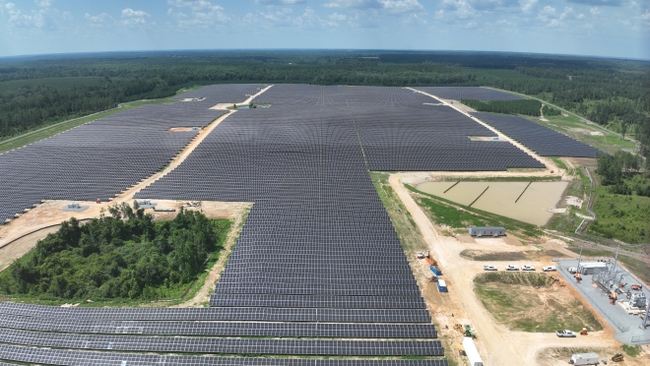
Georgia Power’s generation portfolio remains anchored in fossil fuels. Natural gas accounts for 44% of capacity and coal another 17%, according to the company. Solar makes up 14%, nuclear 12%, hydropower 5%, and wind and biomass 1% each, while demand-side options and oil each contribute 3%. Nuclear generation, concentrated at Plant Vogtle near Waynesboro, Georgia, expanded sharply with the addition of Vogtle Units 3 and 4, the first new reactors to enter commercial service in the United States in more than three decades. The two units add roughly 1.114 GW each, or about 2.228 GW combined, positioning Georgia among the top five nuclear power producers in the country. The company’s solar buildout ranks it among the top ten nationally for that resource. Georgia Power said its overall carbon-free capacity, which includes nuclear, hydro, solar, wind, and biomass, has grown from 20% in 2007 to 36% in 2025.
At 3.2 GW, OpenAI’s Effingham County campus is larger than the combined output of Vogtle’s two new reactors. Meeting that kind of demand, and the rest of the large-load portfolio behind Georgia Power’s savings projections, will lean heavily on the natural gas fleet that still makes up nearly half of the company’s capacity, even as solar and nuclear supply a growing share of the mix. That combination, dispatchable gas paired with expanding carbon-free generation, is central to how Georgia Power is positioning itself to serve artificial intelligence (AI)-driven demand without the kind of rate increases utilities in other states have proposed to fund similar buildouts. It is also why the OpenAI contract includes up to 1 GW of flexible demand response. This hedge lets the data center absorb some of the swings solar introduces, rather than requiring the grid to smooth them out alone.