Europe’s Largest Electrolyzer Enters Operation
Designed To Produce Zero-Carbon Hydrogen, BASF’s Electrolyzer Has The Potential To Reduce Greenhouse Gas Emissions At BASF’s Main Plant By Up To 72,000 Tonnes Per Year
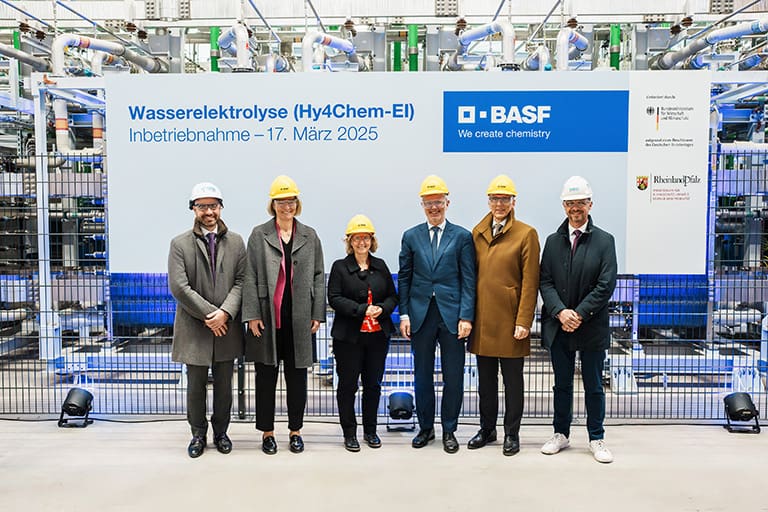
Germany’s largest proton exchange membrane (PEM) electrolyzer has gone into operation at BASF SE’s (BASF) Ludwigshafen site. Designed to produce zero-carbon hydrogen, the electrolyzer has a connected load of 54 MW and the capacity to supply the main plant with up to 1.1 ton (1 tonne) of chemical feedstock every hour. After a construction period of around two years, the plant was officially inaugurated on March 17 in the presence of Katrin Eder, Rhineland-Palatinate state minister for climate protection, environment, energy, and mobility and Udo Philipp, state secretary at the German Federal Ministry for Economic Affairs and Climate Action.
(Image courtesy of BASF SE)
“BASF has embarked on an ambitious path to net zero. In addition to progressively increasing its generation of electricity and process heat from renewable energies, the company also plans to use renewable raw materials as alternatives to the fossil energy sources currently employed, such as natural gas,” said Eder. “Designed to produce green hydrogen as a raw material, the new electrolyzer at the Ludwigshafen location represents an important milestone and supports the achievement of Rhineland-Palatinate’s climate protection targets.”
“I am delighted that the federal government’s efforts to support the hydrogen economy in Germany are bearing fruit. A flagship project for the integration of hydrogen into a chemical production site has become a reality at the Ludwigshafen site,” said Philipp. “It is the largest project of its kind in Germany to date, making it an important pioneer as we strive to achieve our climate targets. Through this collaboration, BASF is demonstrating what decarbonization of the industrial sector can look like in practice and inspiring further technological progress.”
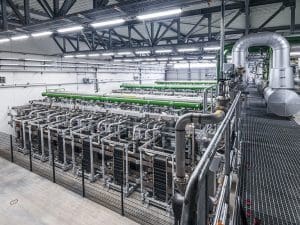
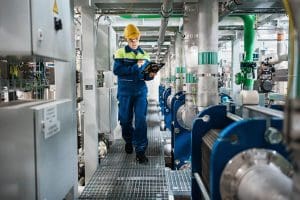
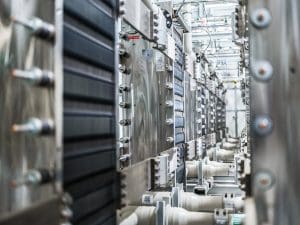
Built in cooperation with Siemens Energy, the water electrolyzer is embedded in the production and infrastructure at the Ludwigshafen site, which is unique in terms of interface and integration into a chemical production environment. A total of 72 stacks have been installed in the system. Stacks are the modules where the electrolysis process takes place. The electrolyzer has the potential to reduce greenhouse gas emissions at BASF’s main plant by up to 79,366 tons (72,000 tonnes) per year.
(Image courtesy of BASF SE)
“The commissioning of the electrolyzer makes it possible for us to support our customers in achieving their climate targets by offering them products with a lower carbon footprint,” said Katja Scharpwinkel, member of BASF SE’s board of executive directors and site director at Ludwigshafen. “At the same time, we are gaining experience at our largest Verbund site with the integration and operation of a system that brings us another step closer to transforming our main plant in Ludwigshafen. We welcome the fact that the federal government and state government have recognized the importance of this technology and provided us with significant support toward the project’s implementation.”
The emission-free production of green hydrogen by using electricity from renewable sources is fundamental to the market ramp-up of chemical products with a reduced carbon footprint. Once produced, the hydrogen is fed into the site’s hydrogen Verbund network and distributed to the production facilities as a raw material. In addition to using it as a feedstock for chemical products, BASF plans to supply hydrogen for mobility in the Rhine-Neckar Metropolitan Region, supporting the development of a hydrogen economy in the area.
(Image courtesy of BASF SE)
In cooperation with the State of Rhineland-Palatinate, the German Federal Ministry for Economic Affairs and Climate Action provided funding of up to US$136 million for the construction of the plant, US$41 million of which was financed by the government of Rhineland-Palatinate. BASF’s investment in the project amounts to around US$27 million. The project, entitled Hy4CHem, was selected as part of the IPCEI Hydrogen expression of interest procedure and subsequently funded as an individual project.
“The commissioning of the electrolyzer at BASF for the production of green hydrogen is a milestone for the ramp-up of the hydrogen economy in Rhineland-Palatinate, Germany, and Europe and an important commitment of BASF to its technology and production site in Ludwigshafen,” said Alexander Schweitzer, minister-president of Rhineland-Palatinate. “With the Hy4Chem project, BASF is impressively demonstrating how the transformation of the energy-intensive chemical industry can succeed – innovatively, sustainably, and internationally competitively. As the state government, we support this process with up to €37.3 million because we are convinced that hydrogen plays a key role in decarbonizing and securing our industrial jobs. Today’s inauguration sends a strong signal for a climate-neutral future and strengthens Ludwigshafen as a business location.”
Among other applications, hydrogen is used in the production of ammonia, methanol, and vitamins. Until now, hydrogen has been produced at the Ludwigshafen location primarily by means of natural gas-based steam reforming or as a coupling product and by-product. With the electrolyzer, BASF said that it is now taking an important step in the transformation of hydrogen production technology.