Europe’s Largest Electrolyzer Enters Operation
The Green Hydrogen Will Primarily Be Used To Produce Low Carbon Chemical Products
(Image courtesy of BASF SE)
(Image Courtesy Of BASF SE)
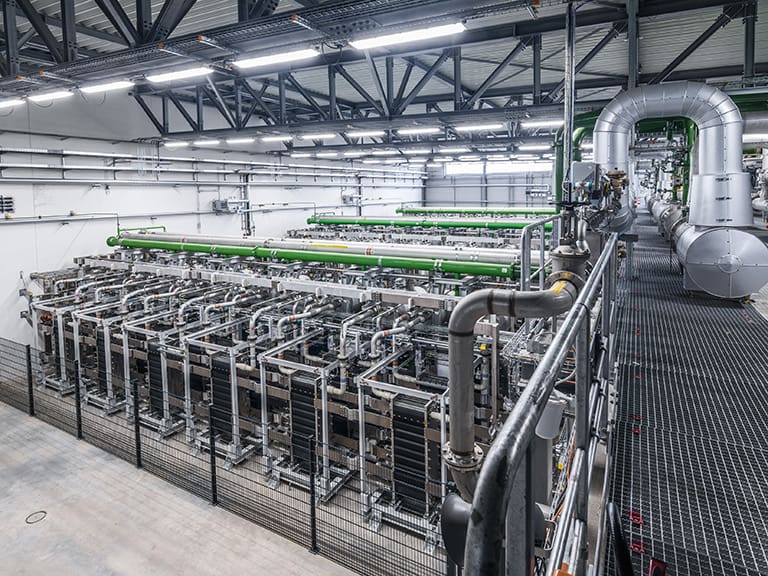
Germany’s largest proton exchange membrane (PEM) electrolyzer has entered operation at BASF SE’s (BASF) Ludwigshafen site. Designed to produce zero-carbon hydrogen (H2), the electrolyzer has a connected load of 54 MW and the capacity to supply the main plant with up to 1.1 ton (1 tonne) of chemical feedstock every hour.
“Ludwigshafen is BASF’s most important site worldwide,” the company commented. “The site is a real-life lab for technologies and approaches in the energy transformation that we are currently implementing or developing. It must respond to changes in the technological, regulatory, and economic environment. Water electrolysis is an example for this. It gives us the opportunity to drive forward the development of a market for “green chemistry”, which BASF needs in order to achieve the goal of net zero CO2 [carbon dioxide] emissions and to promote a CO2-neutral industry in the future.”
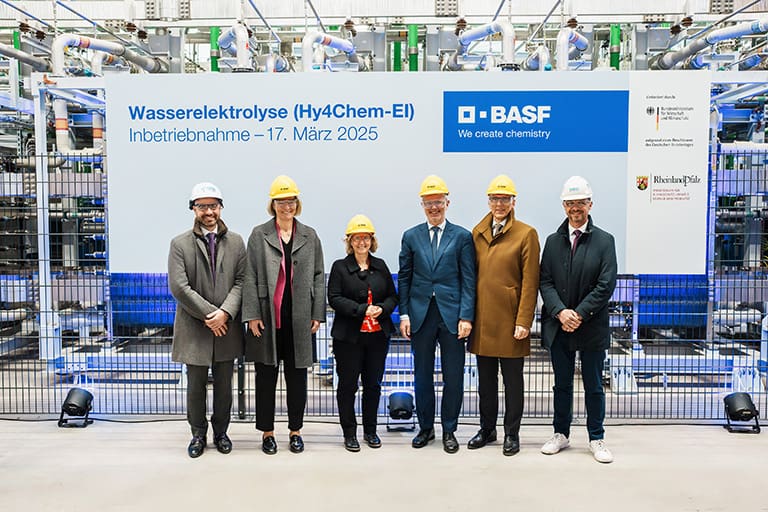
After a construction period of around two years, the plant was officially inaugurated in March in the presence of Katrin Eder, Rhineland-Palatinate state minister for climate protection, environment, energy, and mobility and Udo Philipp, state secretary at the German Federal Ministry for Economic Affairs and Climate Action.
“BASF has embarked on an ambitious path to net zero,” said Eder. “In addition to progressively increasing its generation of electricity and process heat from renewable energies, the company also plans to use renewable raw materials as alternatives to the fossil energy sources currently employed, such as natural gas. Designed to produce green hydrogen as a raw material, the new electrolyzer at the Ludwigshafen location represents an important milestone and supports the achievement of Rhineland-Palatinate’s climate protection targets.”
“I am delighted that the federal government’s efforts to support the hydrogen economy in Germany are bearing fruit. A flagship project for the integration of hydrogen into a chemical production site has become a reality at the Ludwigshafen site,” said Philipp. “It is the largest project of its kind in Germany to date, making it an important pioneer as we strive to achieve our climate targets. Through this collaboration, BASF is demonstrating what decarbonization of the industrial sector can look like in practice and inspiring further technological progress.”
(Image courtesy of BASF SE)
(Image courtesy of BASF SE)
Harnessing Emission-Free Hydrogen
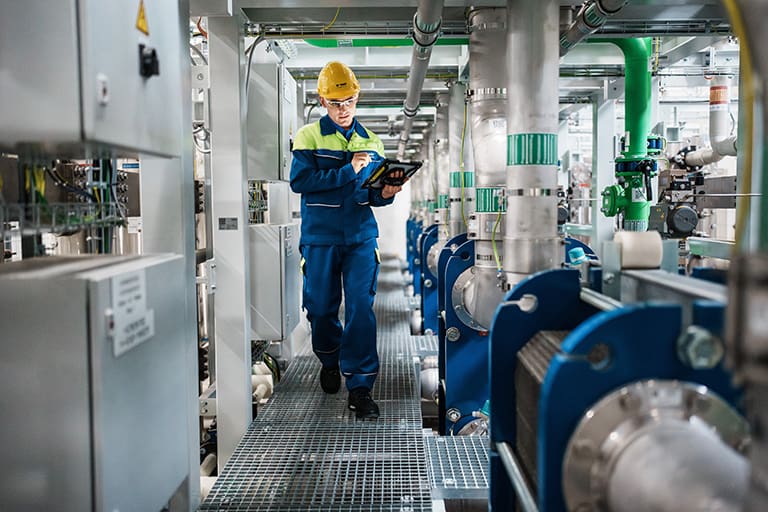
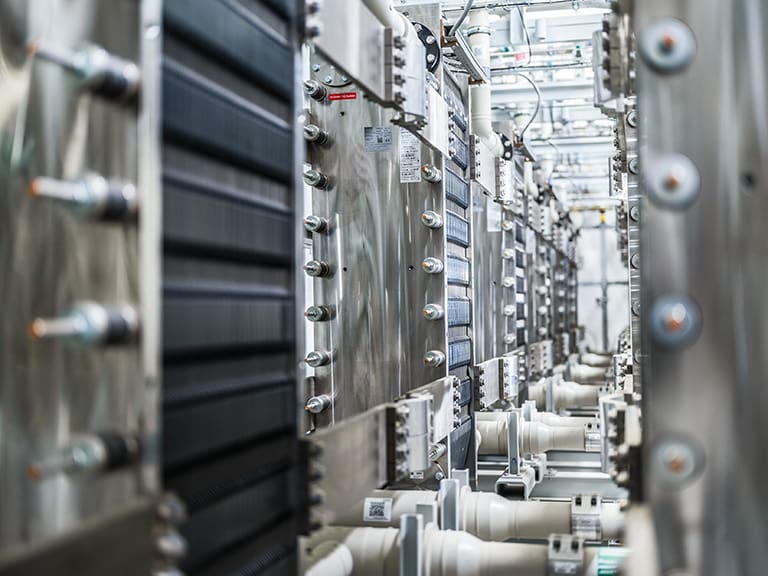
Built in cooperation with Siemens Energy, the water electrolyzer is embedded in the production and infrastructure at the Ludwigshafen site, which is unique in terms of interface and integration into a chemical production environment. A total of 72 stacks have been installed in the system. Stacks are the modules where the electrolysis process takes place. The electrolyzer has the potential to reduce greenhouse gas emissions at BASF’s main plant by up to 79,366 tons (72,000 tonnes) per year.
“Water electrolysis is currently the only technology that enables hydrogen production that relies entirely on energy from renewable sources,” said BASF. “PEM technology has the advantage over other water electrolysis technologies because it has a high load change speed and a short cold start time. This makes it particularly suitable for the dynamic operating mode required in Ludwigshafen. The produced CO2-free hydrogen is initially fed into BASF’s H2 network at the Ludwigshafen site and distributed from here to the respective plants.”
“The commissioning of the electrolyzer makes it possible for us to support our customers in achieving their climate targets by offering them products with a lower carbon footprint,” said Katja Scharpwinkel, member of BASF SE’s board of executive directors and site director at Ludwigshafen. “At the same time, we are gaining experience at our largest Verbund site with the integration and operation of a system that brings us another step closer to transforming our main plant in Ludwigshafen. We welcome the fact that the federal government and state government have recognized the importance of this technology and provided us with significant support toward the project’s implementation.”
The emission-free production of green hydrogen by using electricity from renewable sources is fundamental to the market ramp-up of chemical products with a reduced carbon footprint. Once produced, the hydrogen is fed into the site’s hydrogen Verbund network and distributed to the production facilities as a raw material. In addition to using the hydrogen as a feedstock for chemical products, BASF plans to supply hydrogen for mobility in the Rhine-Neckar Metropolitan Region, supporting the development of a hydrogen economy in the area.
“BASF wants to use the hydrogen produced at the site primarily for its own production,” BASF commented. “With the water electrolyzer, BASF will produce CO2-free hydrogen, which we will primarily use as a raw material for the production of chemical products with a low CO2 footprint. The main customers for the hydrogen produced from the electrolyzer will therefore be production plants at the site. But BASF also wants to contribute to the transformation towards alternative fuels in mobility. Successful hydrogen mobility in the metropolitan region requires CO2-free hydrogen and H2 filling stations. This is where we want to start with our projects and promote a cross-sector hydrogen economy, which in turn has the potential to secure the business location and competitiveness of the region.”
(Image Courtesy Of BASF SE)
Fueling Germany’s Hydrogen Economy
In cooperation with the State of Rhineland-Palatinate, the German Federal Ministry for Economic Affairs and Climate Action provided funding of up to US$136 million for the construction of the plant, US$41 million of which was financed by the government of Rhineland-Palatinate. BASF’s investment in the project amounts to around US$27 million. The project, entitled Hy4CHem, was selected as part of the IPCEI Hydrogen expression of interest procedure and subsequently funded as an individual project.
“The production of green hydrogen in Germany is currently not economically feasible,” said BASF. “The investment costs are very high compared to fossil-based processes. Without the National Hydrogen Strategy and the associated funding opportunities, this type of project could not be carried out. Reducing investment costs by scaling up electrolyzers will be an important building block for future developments.”
“The commissioning of the electrolyzer at BASF for the production of green hydrogen is a milestone for the ramp-up of the hydrogen economy in Rhineland-Palatinate, Germany, and Europe and an important commitment of BASF to its technology and production site in Ludwigshafen,” said Alexander Schweitzer, minister-president of Rhineland-Palatinate. “With the Hy4Chem project, BASF is impressively demonstrating how the transformation of the energy-intensive chemical industry can succeed – innovatively, sustainably, and internationally competitively. As the state government, we support this process with up to US$41.3 million because we are convinced that hydrogen plays a key role in decarbonizing and securing our industrial jobs. Today’s inauguration sends a strong signal for a climate-neutral future and strengthens Ludwigshafen as a business location.”
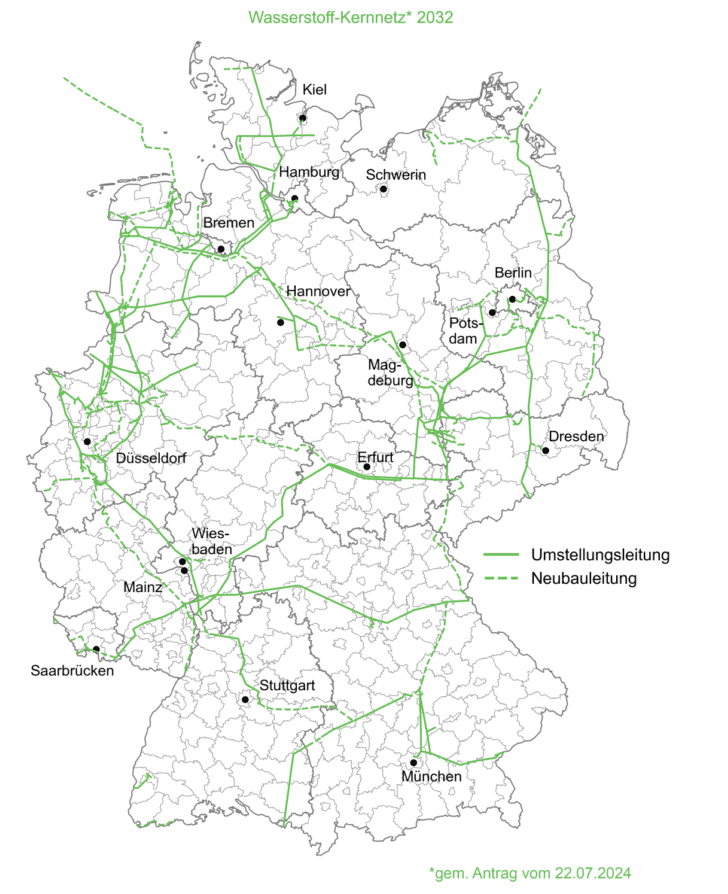
“The success of reducing emissions depends largely on technical, regulatory, and infrastructural requirements, such as the availability of sufficient H2 infrastructure,” commented BASF. “BASF therefore supports a rapid and economically viable hydrogen ramp-up in Germany and Europe and welcomes the plans for the accelerated development of a core network, for which the legislator has created the legal framework in 2024. The Ludwigshafen site will be connected to the Hydrogen Core Network.
Germany plans to complete its 6027 miles (9700 km) Hydrogen Core Network by 2032. According to Germany’s Federal Ministry for Economic Affairs and Climate Action, the total investment costs is forecasted at a whopping US$20.9 billion. About 60% of the pipelines along the network will be converted from natural gas to hydrogen, resulting in an expected feed-in capacity of 101 GW and an exit capacity of 87 GW.
The network will connect areas of hydrogen production to areas of consumption, making it the backbone for hydrogen infrastructure development in Germany. In addition to converting existing natural gas pipelines to hydrogen, the funding for the Hydrogen Core Network includes building new pipelines, compressor stations, and gas pressure reduction and metering systems.
“The production of green hydrogen in Germany is currently not economically feasible. The investment costs are very high compared to fossil-based processes. Without the National Hydrogen Strategy and the associated funding opportunities, this type of project could not be carried out. Reducing investment costs by scaling up electrolyzers will be an important building block for future developments.”
Building Upon Proven Processes
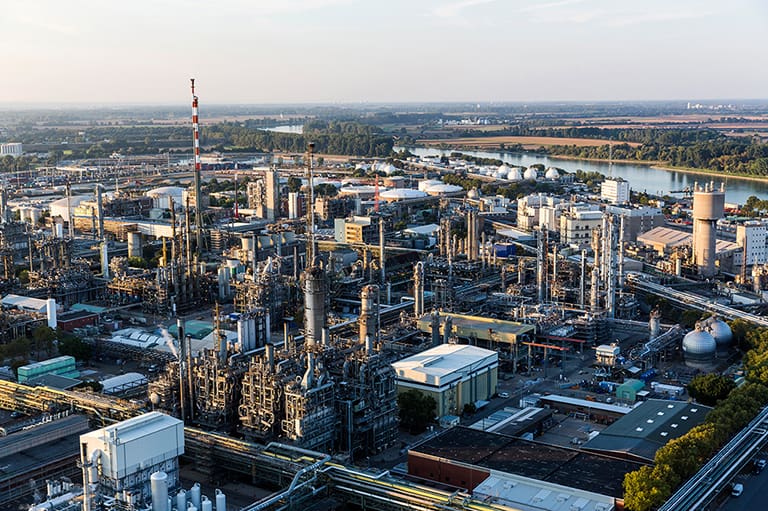
Among other applications, hydrogen is used in the production of ammonia, methanol, and vitamins. Until now, hydrogen has been produced at the Ludwigshafen location primarily by means of natural gas-based steam reforming or as a coupling product and by-product. With the electrolyzer, BASF said that it is now taking an important step in the transformation of hydrogen production technology.
“BASF produces hydrogen using the conventional process of steam reforming of natural gas. In addition, hydrogen is a by-product of chlorine production and steam crackers as well as the partial oxidation of hydrocarbons and chem-cycling feedstocks,” the company commented. “BASF will continue to require large quantities of hydrogen in the future. The prerequisite for the purchase of emission-free or low-emission hydrogen is the availability of corresponding quantities on the market. In order to ensure that hydrogen capacities increase, it is necessary to be open to different forms of H2 production. “Green” hydrogen via water electrolysis is just as much a part of this as “turquoise” hydrogen via methane pyrolysis or “blue” hydrogen via conventional steam reforming in combination with the use of carbon capture and storage. Given the quantities we will need in the long term, the supply of hydrogen via pipeline will also be an important element of the supply.
“The economic use of low-emission hydrogen depends on producing hydrogen at internationally competitive prices and the construction and commissioning of a hydrogen network connecting the major industrial centers.”
(Image Courtesy Of FNB Gas)
A Long Road Ahead
BASF is working to become more efficient in its production and energy use, increase its use of renewable energy, and development and deploy carbon-free processes to produce chemicals. However, the sheer scale and carbon footprint of the Ludwigshafen site means that it will take time for BASF to reach its net-zero goal by 2050.
“With a capacity of up to 8000 tonnes per year, the plant has the potential to save up to 72,000 tonnes of CO2 emissions annually as part of hydrogen production,” commented BASF. “In 2024, the emissions of CO2 equivalents at the Ludwigshafen site amounted to 5.1 million tonnes. This corresponds to a saving of around 1% of CO2 equivalent emissions.”
BASF can’t achieve its environmental targets on its own. The company will depend on the build out of the hydrogen economy. As the network grows, costs should come down, which would make it more economical to produce and transport hydrogen. But for now, the hydrogen economy faces several challenges. “The introduction of new technologies, the associated electrification and the demand for electricity and hydrogen are associated with some challenges,” said BASF. “Providing sufficient quantities of green electricity at globally competitive prices is one of them. We assume that our demand for electricity will rise considerably in the long term. This requires the consistent expansion of renewable energies and the expansion of the electricity infrastructure in Germany. The provision of a hydrogen transportation infrastructure and availability of sufficient quantities of low-CO2 hydrogen at internationally competitive prices is the other challenge. The economic use of low-emission hydrogen depends on producing hydrogen at internationally competitive prices and the construction and commissioning of a hydrogen network connecting the major industrial centers.”
Despite the difficult backdrop, BASF is confident in the long-term opportunities presented by the hydrogen economy.
“For BASF, the current plant is the cornerstone,” the company commented. “It presents the opportunity to lay the foundation for BASF’s own CO2-free production of hydrogen, to gain experience with this technology, which has so far been unusual for the chemical industry, and to promote the market ramp-up of green chemical products based on CO2-free hydrogen.”