Enter The Carbon Destroyer
Carbon Destroyer 1 Will Transport Captured CO2 From Across Europe, Creating A Virtual Pipeline Between The Point Of Capture And Permanent Storage Deep Beneath The Seabed Of The North Sea
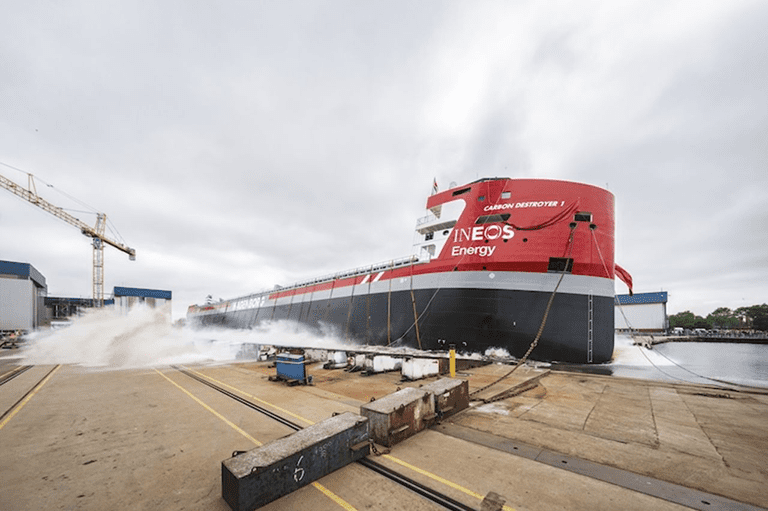
Chemical giant, INEOS Energy, and maritime logistics company Royal Wagenborg launched and named the first European built offshore carbon dioxide (CO2) carrier to enable carbon capture storage across Europe. The launch and naming of Carbon Destroyer 1 builds upon Project Greensand and the EU’s first commercial-scale carbon capture and storage (CCS) value chain.
In November, INEOS and Royal Wagenborg signed a multi-year agreement on the delivery of CO2 transportation. The agreement marked a step toward advancing carbon capture and storage CCS within the European Union. Under the terms of the agreement, Royal Wagenborg will supply a newly built CO2 carrier dedicated to Project Greensand, led by INEOS with its partners Harbour Energy and Nordsøfonden.
Project Greensand had already demonstrated the cross-border transport of CO2 for injection into a depleted oil field. In March 2023, HM King Frederik of Denmark authorized the first injection of CO2 into Danish subsoil in the North Sea.
“The launch of Carbon Destroyer 1 is an important next step for Carbon Capture and Storage in Europe,” said Jim Ratcliffe, chair of INEOS. “We are demonstrating that carbon storage is commercially viable and a far better way to decarbonize Europe without its deindustrialization.”
“This launch is a defining moment for Wagenborg,” said Egbert Vuursteen, chief executive officer (CEO) of Wagenborg. “It combines over a century of maritime experience with a forward-looking vision of sustainability. As the first European-built offshore CO2 carrier, this vessel positions us — and our partners — at the forefront of the energy transition in Europe.”
The Carbon Destroyer 1 carrier is based on Wagenborg’s EasyMax design and has been specially adapted for handling CO2 under pressure and at low temperatures. It is built to the highest safety and environmental standards, aligning with maritime sustainability goals.
Through Project Greensand, Denmark is positioning itself as a hub for CO2 storage in Europe, and Carbon Destroyer 1 will connect emitters with permanent, commercial scale offshore CO2 storage.
“Carbon Destroyer 1 will transport captured CO2 from across Europe, creating a virtual pipeline between the point of capture and permanent storage deep beneath the seabed of the North Sea,” said Mads Weng Gade, CEO of INEOS Energy Europe. “The delivery of the first dedicated offshore CO2 carrier is a prerequisite for commercial scale CCS across the continent.”
The vessel is expected to be fully operational by the end of 2025 or early 2026 – when Project Greensand’s is due to begin permanent commercial scale CO2 storage operations.
The vessel will operate between the Port of Esbjerg in Denmark and the Nini West offshore platform.
In Port of Esbjerg construction is currently underway on a new CO2 terminal, which will serve as the onshore hub for receiving, storing, and loading liquefied CO2 onto the vessel.
Once established, the terminal will include six large storage tanks and essential infrastructure to support continuous and scalable CO2 transport to the offshore storage site.
Captured CO2 – initially from Danish biogas plants – will be delivered to the terminal by truck, temporarily stored, and then transferred to Carbon Destroyer 1. From there, the vessel will sail to the Nini Field, where the CO2 will be injected over 5906 feet (1800 m) beneath the seabed into depleted oil reservoirs that have been certified for safe, long-term storage.