Georgia Bets Big On Battery Storage
765 MW Of Battery Energy Storage Projects Expected To Come Online in 2026
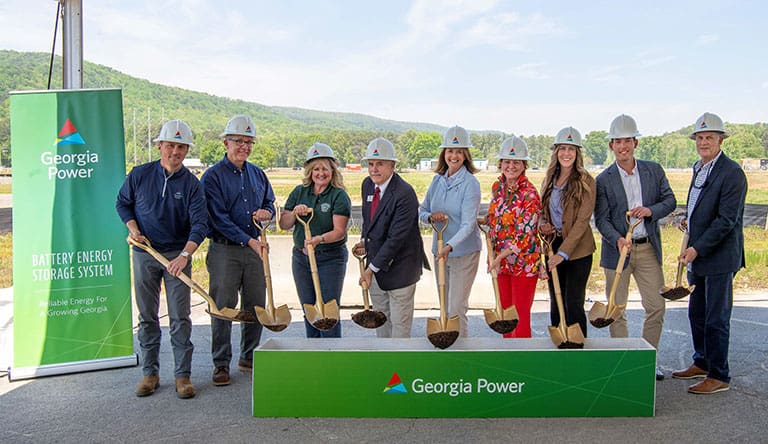
(Image courtesy of Georgia Power)
Georgia Power, the largest electric subsidiary of Southern Company, announced that construction is underway on 765-MW of new battery energy storage systems (BESS) located across Georgia in Bibb, Lowndes, Floyd, and Cherokee counties. The BESS projects were authorized by the Georgia Public Service Commission (PSC) through the Integrated Resource Plan (IRP) process and provide quickly dispatchable capacity for customers.
Building On A Proven Success Story
The new projects follow the company’s first-ever BESS facility at Mossy Branch near Columbus, Georgia which entered service last year. The Mossy Branch BESS is capable of 65 MW of battery storage that can be deployed back to the grid over a four-hour period. Georgia Power worked with Wärtsilä to provide the engineering, procurement, and construction services for the Mossy Branch facility. The project utilizes the GEMS Digital Energy Platform, Wärtsilä’s energy management system, to manage the facility and provide secure operations, and is built with Wärtsilä’s Quantum, a fully integrated, modular, and compact energy storage system.
Georgia Power’s 2025 IRP includes a 10-year plan for new transmission resources across more than 1000 miles (1609 km) of transmission lines, improving the system’s efficiency and resiliency. Georgia Power has also proposed a variety of solutions, including new grid enhancing technologies, to help meet increasing grid capacity needs and enable further integration of the state’s growing solar generation and BESS.
The BESS Advantage
BESS projects support the overall reliability and resilience of the electric system, while also enhancing the value of intermittent renewable generation resources such as solar. Storage systems can improve the efficiency of renewable energy by storing excess energy produced during periods when the demand for electricity is lower, for use when the demand is higher, such as on cold winter mornings. Because battery storage can provide stored energy to the grid for hours on demand, BESS resources enhance the overall reliability of the electric system.
“At Georgia Power, we work with the Georgia PSC and many other stakeholders to make the investments required for a reliable and resilient power grid, integrating new technologies to better serve our customers today and as Georgia grows,” said Rick Anderson, senior vice president and senior production officer for Georgia Power. “As we expand our diverse energy mix to include more renewable energy, which requires careful advance planning and flexibility to accommodate times when that source is not available, these batteries will be an invaluable part of the electric system.”
Projects Under Construction
Construction is currently underway at the following BESS locations:
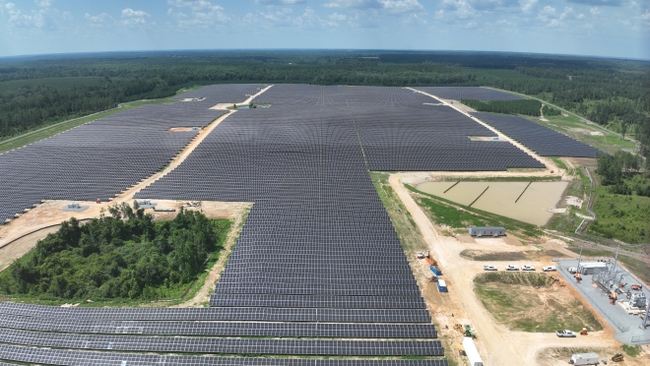
Robins BESS (Bibb County, 128 MW). The site is co-located with the existing solar facility adjacent to the Robins Air Force Base and allows Georgia Power to leverage existing infrastructure, thereby eliminating the need to construct new transmission generator step-up (GSU) project-level substations and eliminating potential expenses and long lead time projects associated with transmission interconnection and network upgrades. This project is being engineered and constructed by Burns & McDonnell and has a projected commercial operation date in June 2026.
Moody BESS (Lowndes County, 49.5 MW). Similar to the Robins BESS project, this project is co-located with the existing solar facility adjacent to the Moody Air Force Base and allows Georgia Power to leverage existing infrastructure, thereby eliminating the need for constructing new transmission GSU project-level substations and eliminating potential expenses and long lead time projects associated with interconnection and network upgrades. It also offers expedited deployment capabilities and ensures known transmission deliverability. This project is being engineered and constructed by and has a projected commercial operation date in May 2026.
Hammond BESS (Floyd County, 57.5 MW). The Hammond BESS project is a standalone BESS that leverages existing infrastructure from the retired coal-fired Plant Hammond facility. With the repurposing of an existing generation site and the utilization of already identified transmission capacity, the Hammond BESS project provides significant benefit to customers while aiding the company in meeting its capacity needs. This project is being engineered and constructed by Crowder Industrial Construction and has a projected commercial operation date in November 2026.
McGrau Ford Phase I & II BESS (Cherokee County, 530 MW). Given the existing site work, land acquisition, and contracting for McGrau Ford Phase I BESS, Georgia Power will realize efficiencies in contracting and construction by using the same construction company and company-owned land. In addition, the preliminary design for McGrau Ford Phase I BESS provides an opportunity for Georgia Power to cost effectively expand the project level substation and generation tie line rather than construct a new project level substation. These projects are being engineered and constructed by Burns & McDonnell, and Phases I & II have projected commercial operation dates in October 2026 and September 2026, respectively.
Future Georgia Power Battery Storage
Georgia Power continues to work with the Georgia PSC to procure and develop BESS projects across Georgia. An additional 1000 MW of new battery energy storage is expected to be procured in the coming years through competitive bidding processes and a 13 MW demonstration project is in development at Fort Stewart Army Installation near Savannah, Georgia. All-source capacity Request for Proposals proposed in the 2025 and 2022 IRPs are also expected to include BESS assets.
Georgia Power’s 2025 IRP includes two customer expansions of BESS programs including enhancements to the Customer Connected Solar Program and launching a new Customer-Sited Solar Plus Storage Pilot. This pilot aims to secure an initial 50 MW of capacity, providing opportunities for residential and small commercial customers to add solar and storage resources. The goal is to encourage more customer-sited renewable generation by pairing dispatchable BESS with behind-the-meter solar systems.