US Natural Gas Production Hits Record High
New Takeaway Capacity, Rising Henry Hub Prices, Higher Gas-To-Oil Ratios Contributed To All-Time High Results In 2025

US marketed natural gas production reached a new record in 2025, growing by 5.3 bcf/d (150.07 x 10⁶ m3/d) to average 118.5 bcf/d (3.3 x 10⁹ m3/d), according to the US Energy Information Administration’s (EIA’s) latest Natural Gas Monthly. Three regions — Appalachia, Permian, and Haynesville — accounted for 67% of the total marketed gas production in the United States in 2025 and for 81% of the growth last year.
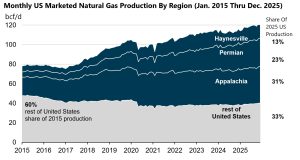
The EIA’s Short-Term Energy Outlook breaks out US Lower 48 (L48) marketed natural gas production data for the Appalachia, Bakken, Eagle Ford, Haynesville, and Permian regions and also includes Alaska and Gulf of America production data. In 2025, Henry Hub spot prices rose by 60% to US$3.52 per MMBtu, contributing to growth across all regions. The Appalachia, Permian, and Haynesville regions accounted for 4.2 bcf/d (118.9 x 10⁶ m3/d) growth, while other regions accounted for the remaining 1.1 bcf/d (31.1 x 10⁶ m3/d) growth.
In 2025, more natural gas was produced in the Appalachia region of the Northeast than in any other US region, accounting for 31%, or 36.6 bcf/d (1.06 x 10⁹ m3/d), of marketed natural gas production. Production growth in the Appalachian region has been slowing in recent years due to limited pipeline takeaway capacity to transport natural gas to demand markets. In June 2024, the Federal Energy Regulatory Commission authorized the Mountain Valley Pipeline to begin operations. With this new capacity addition and higher Henry Hub prices in 2025 relative to the previous year, production in Appalachia grew by 1.1 bcf/d in 2025, compared with an increase of just 46 MMcf/d (1.3 x 10⁶ m3/d) in 2024.
The Permian region in Texas and New Mexico accounted for 23% of the marketed natural gas production in the United States in 2025 and around half the growth in US production. In 2025, marketed natural gas production in the Permian region rose by 11%, or 2.7 bcf/d (76.4 x 10⁶ m3/d), to average 27.7 bcf/d (784.3 x 10⁶ m3/d).
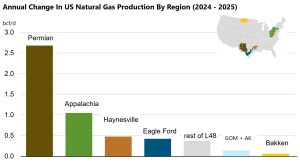
Note: GOM = Gulf of Mexico, AK = Alaska, L48 = Lower 48 US States
In the Permian region, growth in natural gas production is primarily driven by associated gas produced alongside oil. West Texas Intermediate crude oil prices fell from US$77 per barrel in 2024 to US$65 per barrel in 2025. This price continued to support oil-directed drilling in the Permian region. Oil industry executives responding to the Dallas Fed Energy survey report the two largest basins in the Permian had breakeven prices of US$61 per barrel (Midland Basin) and US$62 per barrel (Delaware Basin) in 2025. Additionally, the average gas-to-oil ratio, which has been steadily increasing in the Permian, contributed to the growth in natural gas.
In 2025, production in the Haynesville region, which spans Louisiana and Texas, averaged 14.9 bcf/d (421.9 x 10⁶ m3/d), 4% more than the 2024 annual average. The Henry Hub price increase from 2024 to 2025 enabled drilling in the Haynesville region to remain economically viable, even with relatively deeper and more expensive well development costs. The Haynesville formation is between 10,500 and 13,500 ft (3200 and 4115 m) deep compared with wells that average 4000 to 8500 ft (1219 to 25590 m) deep in the Appalachia region. But Haynesville’s proximity to liquefied natural gas export terminals and major industrial natural gas consumers along the US Gulf Coast draws operators to the region.
About The Author
Naser Ameen is a research analyst with the US Energy Information Administration.